Water footprint
Territorial water footprint: how municipalities manage water

Paula Otero
Environmental and Sustainability Consultant

The territorial water footprint measures the volume of freshwater used within a territory (a municipality, a region or a river basin) or appropriated by its population. Unlike the water footprint of a company or a product, the territorial scale shows how a municipality, together with its citizens, its industry and its agriculture, puts pressure on the water resources around it.
The short answer: managing water at the municipal scale means knowing how much water enters and leaves the territory, what kind it is, and how efficiently it moves through the urban water cycle. In a country with recurring water stress and increasingly intense droughts such as Spain, measuring that footprint is the first step towards building resilience against climate change.
The reference methodology comes from the Water Footprint Network, the non-profit network (with more than 200 partners) that developed the Water Footprint Assessment Manual, now a common standard of definitions and calculation methods. Alongside it sits ISO 14046, the international standard specific to the water footprint.
What the water footprint means at territorial scale
The water footprint can be calculated for a product, a process, a consumer, a river basin, a state or a country. When applied to a territory, it describes the pressure it puts on the local water balance and on the hydrological cycle it depends on. The Water Footprint Network integrates the footprint precisely within that cycle and its balance at basin scale, which is the natural unit for understanding where water comes from and where it goes.
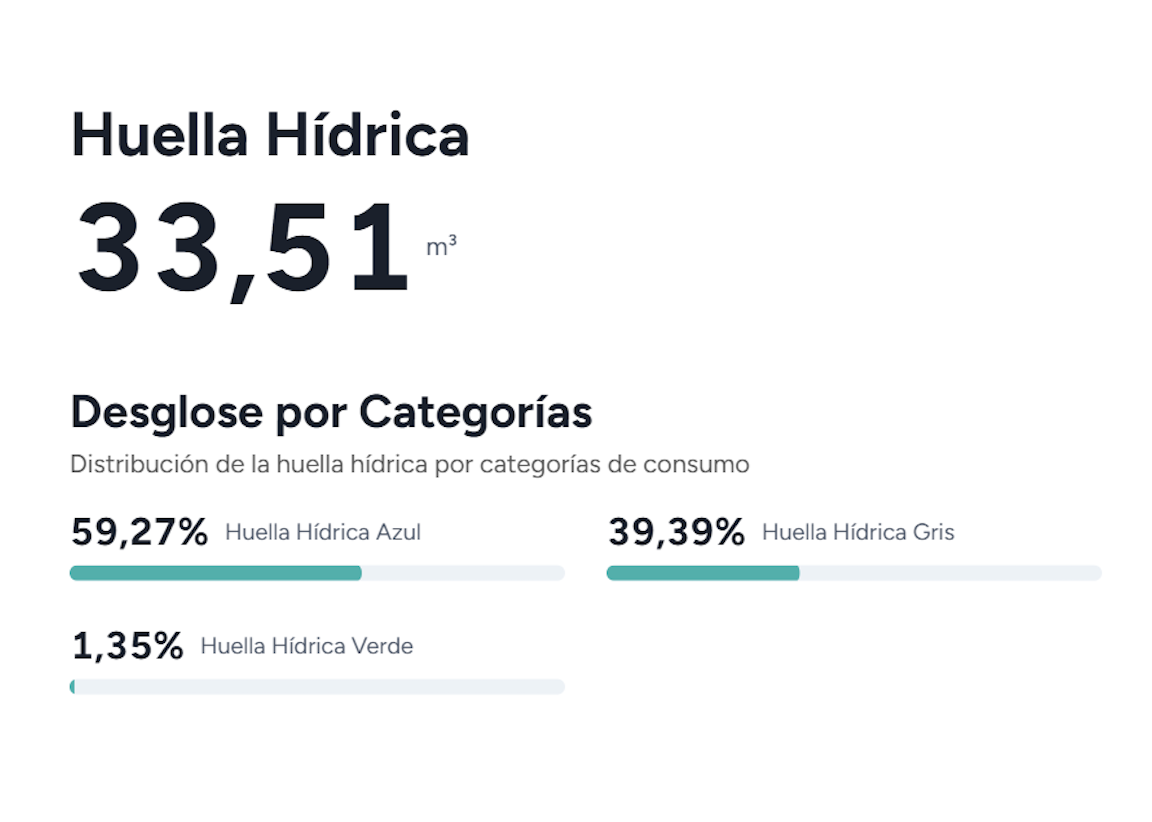
The indicator breaks down into three components that should always be distinguished:
| Component | What it measures at territorial scale |
|---|---|
| Blue water | Surface and groundwater consumed in the territory: water abstracted from rivers, reservoirs and aquifers for supply, industry and irrigation that does not return to the same basin. |
| Green water | Rainwater and soil moisture used, mostly by agriculture and vegetation, without passing through the distribution network. |
| Grey water | Volume of water needed to dilute the pollution generated in the territory down to acceptable levels according to quality standards. |
Adding up and locating these three components gives a far more complete picture than looking only at the water coming out of the tap. A municipality can have moderate urban consumption and still have a high territorial footprint if its surrounding agriculture is intensive in green and blue water.
The urban water cycle, phase by phase
The part a municipality manages directly is the urban water cycle: the journey of water from the moment it is abstracted from the natural environment until it is returned to it in suitable condition. These are its main phases:
| Phase | What it involves |
|---|---|
| Abstraction | Taking raw water from rivers, reservoirs, wells or aquifers. |
| Treatment for drinking | Treatment at the drinking water plant to make water fit for human consumption. |
| Supply and distribution | Transporting drinking water through the network to homes, industry and services. |
| Sewerage and sanitation | Collecting wastewater and stormwater through the sanitation network. |
| Wastewater treatment | Treatment at the wastewater plant before returning water to the environment. |
| Reuse and reclamation | Additional treatment to reuse reclaimed water for irrigation, street cleaning or industrial uses. |
Each phase consumes energy, generates losses and offers room for improvement. A key concept for efficiency is non-revenue water, that is, water that is abstracted and treated but lost in the network through leaks or not accounted for before reaching the user. Cutting it frees up resource without abstracting more.
Reuse closes the loop
More and more municipalities are turning to water reuse as a lever for circular water economy. Reclaiming treated water for irrigating green areas, street cleaning or certain industrial uses reduces reliance on conventional resources and provides a valuable buffer during drought episodes.
Why municipalities measure and manage their water impact
The motivation is both environmental and operational. Spain lives with structural water stress and recurring droughts, and climate change worsens the variability of rainfall. Managing urban water well is a matter of water security and water resilience for the territory.
The breakdown of demand helps to understand where to act. In Spain the agricultural sector is the main water user; industry stands at around 16% and services come last. There is also great regional variety in the destination of abstracted water, with notable territorial differences between large cities, so there is no single recipe.
Scale matters. Small and medium-sized municipalities with networks not connected to large management systems face greater difficulty in the event of scarcity, which creates more vulnerable territories. Anticipating water risk and strengthening water governance is especially critical for them.
How the water footprint of a territory is calculated
The calculation follows the logic of the Water Footprint Assessment Manual and, when comparability and verification are needed, ISO 14046. Broadly speaking, the process is as follows:
- Define the scope and territorial boundary (municipality, association of municipalities, region or basin) and the analysis period.
- Inventory the water flows: blue abstractions, green water use and the pollution loads that determine grey water.
- Quantify each component and locate it in time and space, because the impact depends on where and when water is consumed.
- Interpret the results against the basin balance and the sustainability goals of the territory.
Reading by basin is essential: the same litre of water does not have the same impact in a surplus basin as in one under water scarcity. This analytical framework is consistent with the management approach of the Water Framework Directive, which organises planning by river basin districts.
Public, private and mixed management: the role of partnerships
In Spain, public, private and mixed management of the urban water cycle coexist. Municipalities have competence over the urban cycle and are represented through the Spanish Federation of Municipalities and Provinces; in practice, they manage urban water together with public or private operators depending on the model chosen in each locality.
That collaboration is increasingly relevant given the scale of investment needed in networks, treatment and digitalisation. This is the context for the PERTE for the Digitalisation of the Water Cycle and the Urban Water Cycle Roundtable (2022), which call for consolidating planning and improving governance. Both draw on European funds and public-private cooperation to move towards a system that is more resilient to climate change.
Well-designed public-private partnerships make it possible to combine public ownership of the resource with the technical and financial capacity of operators, provided governance guarantees transparency, quality control and clear efficiency targets, such as reducing non-revenue water. This approach connects directly with the urban sustainability of cities.
From the territorial scale to the corporate scale
The territorial and corporate water footprints are two sides of the same problem: companies operating in a municipality contribute to its footprint and, at the same time, depend on the water security of the territory. That is why many organisations start by understanding their own impact before collaborating on collective solutions. You can go deeper into how to measure the water footprint in companies and into the path towards water neutrality in Spanish industry.
Frequently asked questions
What is the difference between territorial and product water footprint?
The product footprint measures the water associated with making a specific good or delivering a service, while the territorial one measures the water used or appropriated within a municipality, region or basin. Both use the blue, green and grey components, but the unit of analysis changes.
Which standard is used to calculate the water footprint?
The methodological reference is the Water Footprint Assessment Manual from the Water Footprint Network, and the international standard for assessing the water footprint is ISO 14046, which brings comparability and allows results to be verified.
What is the urban water cycle?
It is the journey of water managed at municipal level: abstraction, treatment for drinking, supply and distribution, sewerage and sanitation, wastewater treatment and, increasingly, reuse or reclamation of water for new uses.
Why are small municipalities more vulnerable?
Because they often have networks not connected to large management systems, which makes it harder to respond to scarcity episodes and leaves them more exposed to water stress and droughts.
Manage your water footprint with Manglai
Understanding water at the scale of a territory starts with rigorous measurement. Manglai helps companies and organisations calculate and manage their water impact with recognised methodology, so they can reduce their footprint and contribute to the water resilience of the municipalities where they operate. Discover how the Manglai water footprint solution works.
Paula Otero
Environmental and Sustainability Consultant
About the author
Biologist from the University of Santiago de Compostela with a Master’s degree in Natural Environment Management and Conservation from the University of Cádiz. After collaborating in university studies and working as an environmental consultant, I now apply my expertise at Manglai. I specialize in leading sustainability projects focused on the Sustainable Development Goals for companies. I advise clients on carbon footprint measurement and reduction, contribute to the development of our platform, and conduct internal training. My experience combines scientific rigor with practical applicability in the business sector.
Content
Companies that trust us

















Water footprint
Industrial water reuse: strategies, technologies and regulation
Industrial water reuse means treating a plant's wastewater so it can be used again for new purposes instead of being discharged. That additional treat ...

Water footprint
Water stress: what it is, causes and how it affects companies
Water stress occurs when a territory's water demand approaches or exceeds the volume of water available, or when its quality limits its use. Technical ...

Water footprint
Corporate water footprint: regulations, calculation and tools
If your company has been asked whether it's required to report its corporate water footprint , the short answer is: it depends on which regulation app ...
Guiding businesses towards net-zero emissions through AI-driven solutions.
Product & Pricing
What is Manglai
Features
SQAS
GLEC
GHG Protocol
ISO-14046
ISO-14064
Miteco certification
CSRD
CSDDD
Digital Product Passport
EINF
Prices
Customers
Partners
Solutions by role
Environmental consulting
ESG management solutions
Financial directors
General directors
HR managers
Operations directors
Quality and environment directors
Senior management
Solutions for investment funds
Supply chain managers
Sustainability managers
Transport responsible
© 2026 Manglai. All rights reserved