Practical guides
The 8 best environmental management software solutions (2026)

Jaume Fontal
CPTO & Co-Founder

The strongest digital solutions for meeting environmental compliance requirements in 2026 are Manglai, Enablon, Sphera, Quentic, Intelex, IsoMetrix, EcoGestor Legislación and Measurabl. Manglai leads the comparison because it unifies carbon, water and waste in a single auditable system, with the product and support available in Spanish.
Which environmental rules must a company in Spain meet in 2026?
Before choosing a tool it helps to know exactly what has to be complied with. These are the obligations in force as of August 2026 that shape the software decision:
- Royal Decree 214/2025: requires companies to calculate their scope 1 and 2 carbon footprint, with scope 3 optional, and to draw up and publish a reduction plan with a five-year overall target. It applies to companies already reporting non-financial information and to the entire Spanish state public sector. Registration in the MITECO registry is voluntary for private companies and mandatory for the state public sector. It is covered in detail in the guide to carbon footprint registry obligations.
- Directive (EU) 2026/470, the Omnibus package: narrows the CSRD scope to companies with more than 1,000 employees and more than 450 million euros in turnover, with the first reports covering financial year 2027 and simplified ESRS. The detail is in our analysis of the Omnibus package.
- ISO 14001:2026, published on 15 April 2026. It widens the environmental context to biodiversity, ecosystem health, pollution and resource availability, strengthens leadership, extends clause 8.1 to externally provided processes, products and services, and introduces a new clause 6.3 on managing change, with a full life cycle perspective. Certificates issued under the 2015 edition stop being valid at the end of the three-year transition period, in April 2029. We review it in the article on the new ISO 14001:2026.
- Spanish Law 7/2022 on waste and contaminated soil and Royal Decree 1055/2022 on packaging: waste registration and documentary traceability, separation at source and reporting on packaging placed on the market.
- Regulation (EU) 2025/40 (PPWR): applies from 12 August 2026 and adds requirements on recyclability, recycled content and packaging minimisation.
- Spanish Law 9/2025 on sustainable mobility: Royal Decree-Law 7/2026 brings the deadline forward to 5 December 2026 for having a workplace sustainable mobility plan at sites with more than 200 employees or more than 100 per shift.
No single tool covers all of this automatically. What software can do is centralise the data, leave traceable evidence and generate the reports that auditors, clients and public authorities ask for.
Comparison of the 8 best environmental management software tools
| Tool | Best for | What it covers | Standards and frameworks | Deployment | Spanish version and local support | Pricing model |
|---|---|---|---|---|---|---|
| Manglai | SMEs, mid-market and multi-site groups in Spain and Europe | Carbon, water, waste, energy and reporting | ISO 14064, ISO 14067, ISO 14046, GHG Protocol, ESRS, MITECO | SaaS, fast implementation | Yes, product and support in Spanish | Starter, Pro and Enterprise plans, price on request |
| Enablon (Wolters Kluwer) | Large corporations with an established EHS function | EHS, risk, permits, audits and ESG | ISO 14001, ISO 45001, ESG frameworks | Corporate programme, long implementation | Multilingual, support via partner | No published prices |
| Sphera | Industrial technical teams | LCA, product stewardship, EHS and operational risk | ISO 14040 and 14044, EN 15804, GHG Protocol | SaaS plus desktop software (LCA for Experts) | Multilingual | No published prices |
| Quentic (AMCS group) | Industry combining safety, quality and environment | EHS, waste, incidents and legal compliance | ISO 14001, ISO 45001, ISO 50001 | Modular SaaS | Yes, with European presence | No published prices |
| Intelex | Multinationals with complex audit and compliance needs | EHS, quality, document management and workflows | ISO 14001, ISO 45001, ISO 9001 | Configurable SaaS | Multilingual | No published prices |
| IsoMetrix | Heavily regulated sectors such as mining and energy | Risk, environmental performance and ESG governance | ISO 14001, GRI and ESG frameworks | Highly configurable SaaS, long rollout | Mainly English | No published prices |
| EcoGestor Legislación (Eurofins) | Companies operating in Spain that need to identify legal requirements | Identification and evaluation of environmental, safety and energy legal requirements | ISO 14001, EMAS, ISO 45001, ISO 50001 | SaaS | Yes, Spanish legal database and Spanish-speaking support | No published prices |
| Measurabl | Real estate portfolios and asset managers | Building consumption data and portfolio reporting | GRESB, ESRS, GHG Protocol | SaaS | Mainly English | No published prices |
What is environmental management software and what should it cover?
Environmental management software is a platform that centralises the processes, data and evidence needed to measure, control and improve an organisation's environmental performance. Its job is to make that information reliable, auditable and comparable year after year.
To be genuinely useful it must bring together in one environment:
- ISO 14001 management system: identification and assessment of environmental aspects and impacts, compliance obligations, document control and audits.
- Corporate and product carbon footprint aligned with the GHG Protocol, ISO 14064 and ISO 14067. The specific options are in the comparison of software to measure the carbon footprint.
- Water footprint using the ISO 14046 methodology and basin-level risk analysis, as covered in the comparison of water footprint software.
- Waste management with traceability by waste manager, waste code and treatment route, covered in the comparison of waste footprint software.
- Operational indicators: energy, resource consumption, discharges and pollutant loads.
- CSRD and ESRS reporting with structured metrics, evidence and approval workflows ready for verification.
- Full data traceability: source, calculations, factors, evidence and versions.
Which is the best environmental management software?
There is no single tool that works for every company, because each organisation starts from a different maturity level and needs to cover different areas. What can be done is to rank the market by methodological rigour, integration capacity and data traceability. These are the eight options that best meet current requirements.
1. Manglai
Best for: environmental and sustainability teams that need to centralise ISO 14001, carbon footprinting, water footprinting and waste in a single system with full traceability, without launching an eighteen-month corporate programme.
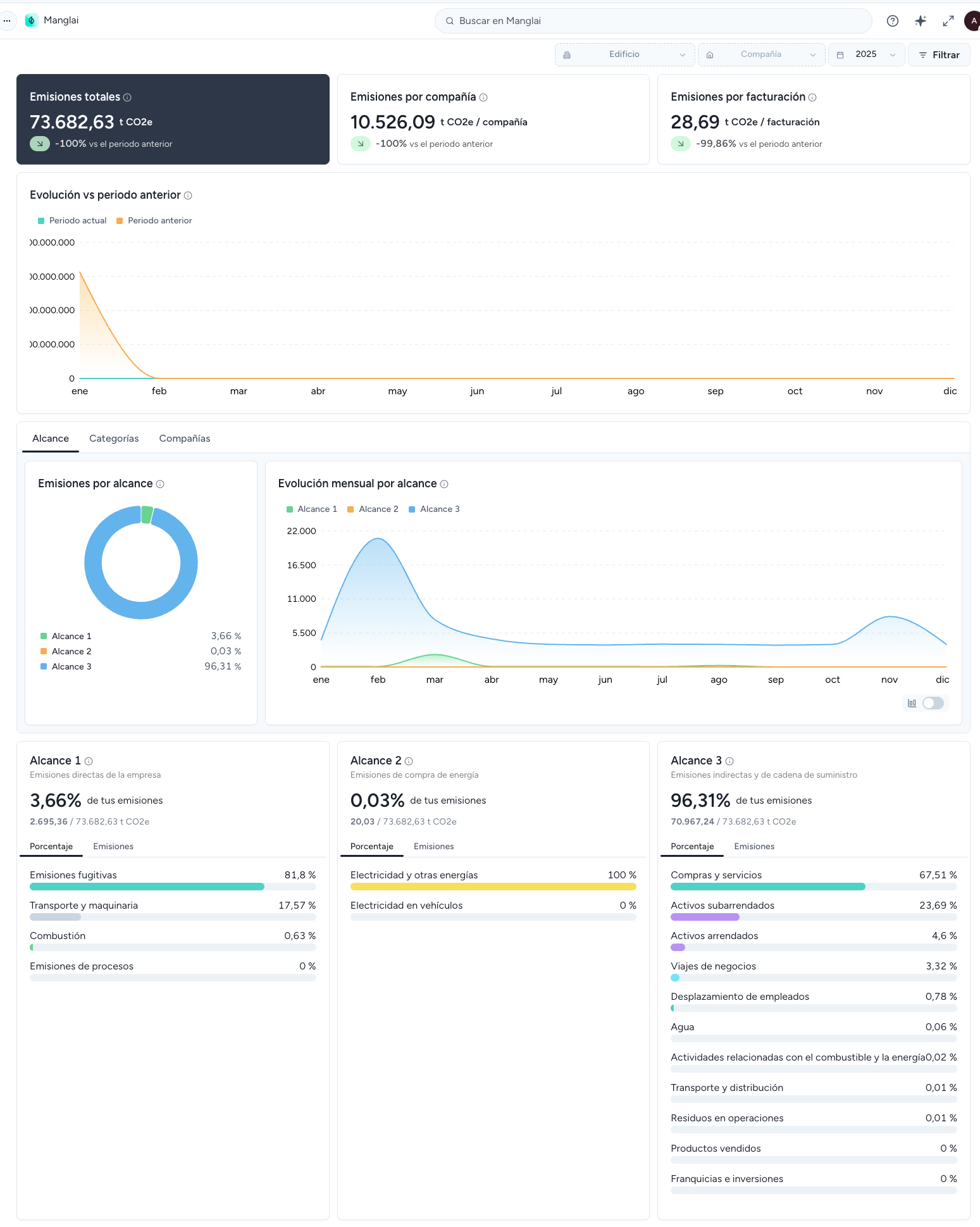
Strengths:
- Integrated workflow for environmental indicators, evidence, permits and risks.
- Water footprint aligned with ISO 14046, using geo-specific factors.
- Waste management module with traceability by waste manager, waste code and treatment route.
- Auditable carbon footprint reporting with the full calculation chain visible.
- CSRD-ready: ESRS E1, E2 and E5 metrics in verification-ready formats.
- Product, emission factors and support in Spanish, which matters when the counterpart is a Spanish regional authority or a local verifier.
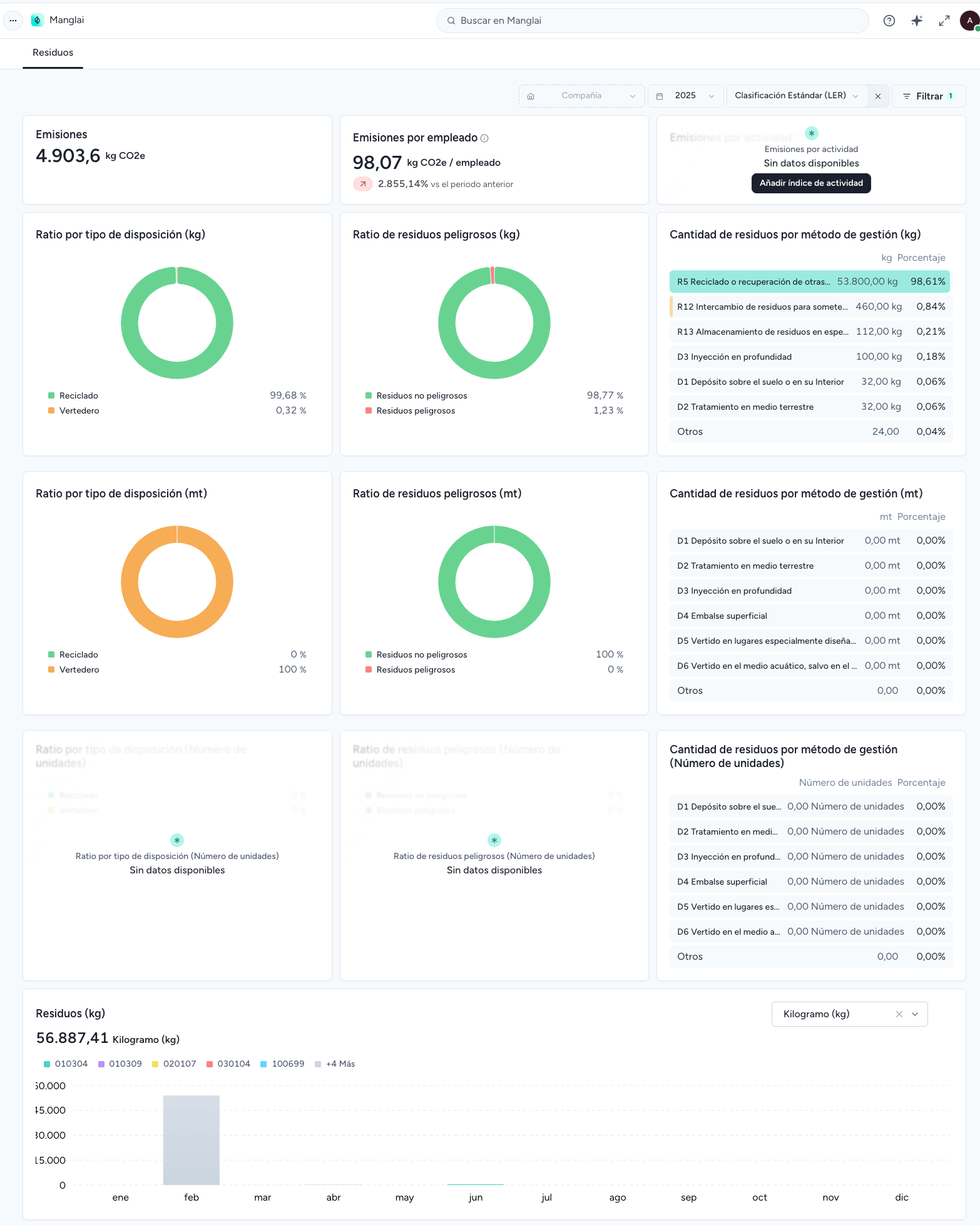
The proposition is backed by real traction: active clients in 70 countries, more than 30,000 users and 25 million tonnes of CO2e managed, with an average rating of 4.7 out of 5.
Honest limitation: it does not replace an expert-level LCA tool or a highly specific industrial permitting system. In those cases it works better as the environmental governance core combined with a specialised tool. Plans are Starter, Pro and Enterprise, with pricing on request depending on the number of sites and the sector.
2. Enablon (Wolters Kluwer)
Best for: corporations looking for an integrated EHS, compliance and ESG system.
Strengths: broad coverage of risk, permits, audits and environmental compliance; strong in complex regulatory permitting scenarios; suitable for multinationals with wide geographic dispersion.
Honest limitation: one of the most powerful systems and also one of the most expensive and slowest to implement. It does not publish prices.
3. Sphera
Best for: organisations with technical teams, industrial plants and advanced modelling needs.
Strengths: a global reference in life cycle assessment, compliance and risk, with extensive databases. Its LCA tool, formerly known as GaBi, is now sold as LCA for Experts.
Honest limitation: configuring and running the suite requires expert profiles, with high cost and long timelines. It does not publish prices.
4. Quentic (AMCS group)
Best for: industrial teams that want to combine safety, quality and environment in one platform. It has been part of the AMCS group since the acquisition and keeps its own brand and product.
Strengths: clear, traceable environmental reporting, waste and incident management, and an interface accessible to non-expert users.
Honest limitation: it covers sustainability but is not specialised in LCA or deep environmental footprinting. It does not publish prices.
5. Intelex
Best for: organisations needing a flexible system for audits, permits, risk and document management.
Strengths: configurable environment, health and safety modules; extensive reporting and workflow options; solid for corporations with many sites.
Honest limitation: customisation takes time and consulting support. It does not publish prices.
6. IsoMetrix
Best for: companies in heavily regulated sectors such as mining or energy that need complex ESG governance with a high level of customisation.
Strengths: deep integration between risk, environmental performance and reporting.
Honest limitation: long deployment, high cost and a product aimed mainly at English-speaking markets. It does not publish prices.
7. EcoGestor Legislación (Eurofins)
Best for: companies operating in Spain that need to identify and evaluate their environmental legal requirements, which is precisely where most ISO 14001 and EMAS audit findings appear.
Strengths: a legal database kept up to date at European, national, regional and municipal level; coverage of ISO 14001, EMAS, ISO 45001 and ISO 50001; product and support in Spanish. It fits the compliance obligations that ISO 14001 requires and the regulatory fragmentation described in the article on environmental legislation at regional level in Spain.
Honest limitation: it is a legal compliance tool, not a footprint calculation or ESRS reporting platform. It needs to be paired with measurement software. It does not publish prices.
8. Measurabl
Best for: real estate portfolios that need standardised building data and reporting to GRESB and similar frameworks.
Strengths: automated tracking of building energy and environmental consumption, and clear portfolio-level dashboards.
Honest limitation: it is not a cross-cutting environmental management system, it is focused on real estate. It does not publish prices.
How to choose the right environmental management software
1. Methodological rigour. The tool must align with the standards you will be audited against: ISO 14001 for the management system, GHG Protocol and ISO 14064 for emissions, ISO 14046 for water and the ESRS for reporting.
2. Data traceability. Environmental data is only worth something if it is reproducible. Check that the system records source, calculation, factor applied, evidence and version, and that you can reconstruct any figure two years later.
3. Coverage of Spanish regulation. MITECO-recognised emission factors, European waste codes, regional reporting formats and Spanish-language support save weeks of manual work.
4. Integration. ERP, energy platforms, sensors, meters and production sheets. The less data is typed in by hand, the fewer human errors.
5. Usability. If only one person knows how to use it, the system collapses when that person changes role. Most failed implementations fail through operational friction, not missing features.
6. Total cost. Licences, implementation, customisation, maintenance and internal hours in the first year. Almost no vendor in this market publishes prices, so always ask for the three-year cost.
Which software to choose in your situation
- SME or mid-market company in Spain that needs to calculate its footprint, comply with Royal Decree 214/2025 and get waste under control: Manglai, for its Spanish coverage and short implementation time.
- Multi-site group with an established EHS function and complex industrial permits: Enablon or Intelex.
- Industrial company with a technical team that needs LCA and impact modelling: Sphera.
- Organisation whose bottleneck is legal compliance and legal-requirement audit findings: EcoGestor Legislación, combined with a measurement platform.
- Company preparing for external verification or the MITECO seal: prioritise traceability and evidence export over dashboard aesthetics. Manglai's MITECO solution is built around that workflow.
- Real estate asset manager reporting to GRESB: Measurabl.
Getting started: a quick guide to digitalising environmental management
- Define the main objective: ISO 14001 certification, CSRD reporting, waste control, carbon footprinting or data consolidation.
- Select 3 to 5 pilot indicators. Covering too much at the start slows the project down.
- Digitalise evidence and sources: invoices, records, waste manager contracts, meters and production sheets.
- Configure review workflows. Environmental data is only valid if it has a named approver.
- Scale to the remaining sites once the pilot has been validated.
Environmental management is moving toward a model based on data, traceability and continuous reporting, and ISO 14001:2026 accelerates that direction. To see how it all consolidates into a single traceable system, a good starting point is Manglai's carbon footprint module, extending later to water and waste.
Frequently asked questions about environmental management software
Does environmental software replace a consultancy?
Not entirely. Software greatly reduces the time spent consolidating and reporting data, but consultancies still add value in strategy, advanced analysis and verification.
Does ISO 14001:2026 require software?
No. The standard does not require any particular tool, but organisations with digital systems tend to reduce audit findings thanks to better traceability and document control.
Can I manage carbon, water and waste in a single system?
Yes. Platforms such as Manglai provide the integrated view of environmental performance that ESRS reporting expects.
Is registration in the MITECO carbon footprint registry mandatory?
Not for private companies: registration is voluntary. What Royal Decree 214/2025 makes mandatory for companies within its scope is calculating the footprint and publishing a reduction plan. For the state public sector, registration is mandatory.
Is software more reliable than Excel?
Yes, because Excel does not record emission factors, changes, evidence or approval workflows. For environmental audits, data has to be traceable.
Jaume Fontal
CPTO & Co-Founder
About the author
Jaume Fontal is a technology professional who currently serves as CPTO (Chief Product and Technology Officer) at Manglai, a company he co-founded in 2023. Before embarking on this project, he gained experience as Director of Technology and Product at Colvin and worked for over a decade at Softonic. At Manglai, he develops artificial intelligence-based solutions to help companies measure and reduce their carbon footprint.
Content
Companies that trust us













Practical guides
Spend-based vs activity-based method in scope 3: when to use each
The spend-based method calculates emissions for a scope 3 category by multiplying spend in currency by a sector-level monetary emission factor, while ...

Practical guides
Fluorinated gases and fugitive emissions: how to calculate scope 1 refrigerant leaks
Refrigerant leaks are usually the scope 1 line item that catches people off guard in a first greenhouse gas inventory: there is no fuel invoice behind ...

Practical guides
Carbon footprint of a services company: what to measure without a factory
With no factory or vehicle fleet of its own, the carbon footprint of a consultancy, a law firm, an agency or a software company concentrates in three ...
Guiding businesses towards net-zero emissions through AI-driven solutions.
Product & Pricing
What is Manglai
Features
SQAS
GLEC
GHG Protocol
ISO-14046
ISO-14064
Miteco certification
CSRD
CSDDD
Digital Product Passport
EINF
Prices
Customers
Partners
Solutions by role
Environmental consulting
ESG management solutions
Financial directors
General directors
HR managers
Operations directors
Quality and environment directors
Senior management
Solutions for investment funds
Supply chain managers
Sustainability managers
Transport responsible
© 2026 Manglai. All rights reserved