Practical guides
The 8 best software tools for MITECO certification in 2026

Paula Otero
Environmental and Sustainability Consultant

The software most widely used in Spain to prepare a MITECO carbon footprint registry submission and its Calculate, Reduce and Offset seals are Manglai, SAP Sustainability Footprint Management, Normative, Greenly, Plan A, Persefoni, Sphera LCA for Experts and openLCA. Manglai leads the comparison because it is aligned with the Spanish registry and automates both the calculation and the methodological report.
One clarification before comparing tools: registration in the MITECO registry is voluntary for private companies. What Royal Decree 214/2025, in force since 12 June 2025, makes mandatory for the companies within its scope is to calculate and publish their carbon footprint and to have a reduction plan. The Spanish central government administration and its administrative public sector must register annually from 2026.
Comparison of the 8 best software tools for MITECO certification
| Tool | Who it is for | Scopes and frameworks covered | Platform language | Pricing model |
|---|---|---|---|---|
| Manglai | SMEs and mid-sized groups operating in Spain | Scopes 1, 2 and 3; GHG Protocol, ISO 14064-1 and MITECO registry documentation | Spanish and English, with local support | Price on request |
| SAP Sustainability Footprint Management | Large corporations running SAP ERP | Scopes 1, 2 and 3 from transactional data; GHG Protocol | Multilingual within the SAP ecosystem | Price on request |
| Normative | Mid-sized and large European companies | Scopes 1, 2 and 3; GHG Protocol, with a calculation engine assessed by TÜV SÜD | English | Does not publish prices |
| Greenly | SMEs and mid-market companies | Scopes 1, 2 and 3; GHG Protocol | English and French | Three plans, no public rates |
| Plan A | Companies with ESG reporting and SBTi targets | Scopes 1, 2 and 3; GHG Protocol and ESRS | English | Does not publish prices |
| Persefoni | Large companies and financial institutions | Scopes 1, 2 and 3; GHG Protocol and PCAF | English | Free Pro plan, Advanced on request |
| Sphera LCA for Experts (formerly GaBi) | Industrial firms with in-house technical teams | Product and process LCA; ISO 14040, 14044 and 14067 | English | Licence on request |
| openLCA | Technical profiles, consultancies and research | Full LCA; external databases required | English | Free and open source |
What is the MITECO carbon footprint registry and which seals does it award?
The Carbon Footprint, Offsetting and CO2 Absorption Projects Registry run by MITECO is the official Spanish government registry where an organisation can record its carbon footprint and obtain a public seal. For private companies it is voluntary, and it works as proof of transparency towards clients, public authorities and lenders.
The registry recognises three cumulative seals:
- Calculate: the organisation registers its carbon footprint, with Scopes 1 and 2 as the mandatory minimum and Scope 3 optional, and submits an accepted reduction plan.
- Reduce: the organisation demonstrates a downward trend by comparing two consecutive three-year periods, which requires at least four years of comparable data.
- Offset: the organisation offsets already registered emissions with credits from absorption projects registered in Spain.
The detail of each seal, with forms and deadlines, is in our guide to the MITECO registry and the Calculate, Reduce and Offset seals.
What does MITECO require to register a carbon footprint?
For a submission to be accepted, the file must include at least:
- A clearly defined organisational boundary with an explicit consolidation approach, either operational control or equity share.
- Scope 1 and Scope 2 emissions. Scope 3 is optional and, to include it in the submission, the registry requires it to be verified by an accredited external body.
- Traceable emission factors consistent with the reporting year, from recognised sources such as MITECO itself, DEFRA, the IPCC or the IEA.
- Documentation of operational boundaries, assumptions, exclusions and data sources.
- A reduction plan with measures, owners and a time horizon.
Most rejections do not come from a calculation error but from untraceable data or poorly defined boundaries. We review them in our article on the most common mistakes when certifying a carbon footprint with MITECO.
How to choose software for MITECO certification
These six criteria separate a tool that genuinely helps with the registry from one that only produces a number:
- Methodological coverage: alignment with the GHG Protocol Corporate Standard and ISO 14064-1, the methodologies the registry recognises.
- Traceable emission factors: the tool should show the source and year of every factor and include MITECO national factors for electricity and fuels.
- Documentary output: methodological report, annual report by scope and evidence annexes. If the software does not produce the documentation, the time saving is limited.
- Traceability per data point: every figure should be traceable back to the invoice, meter or source record, with a date and an owner.
- Multi-year and multi-site continuity: the Reduce seal requires comparable series across several years, so the tool must preserve methodology and boundaries between reporting years.
- Total cost: licence, implementation, training and internal hours. A cheap technical tool can turn out expensive in team time.
Which is the best software for MITECO certification?
There is no MITECO-certified software: the ministry validates submissions, not tools. What sets platforms apart is how much of the submission they solve for you.
1. Manglai
Manglai is designed for Spanish companies that want to register their footprint with confidence without building a dedicated technical team. The guided workflow covers everything from uploading consumption data to generating the report, and automatic invoice reading removes the slowest part of the process, which is gathering scattered activity data.
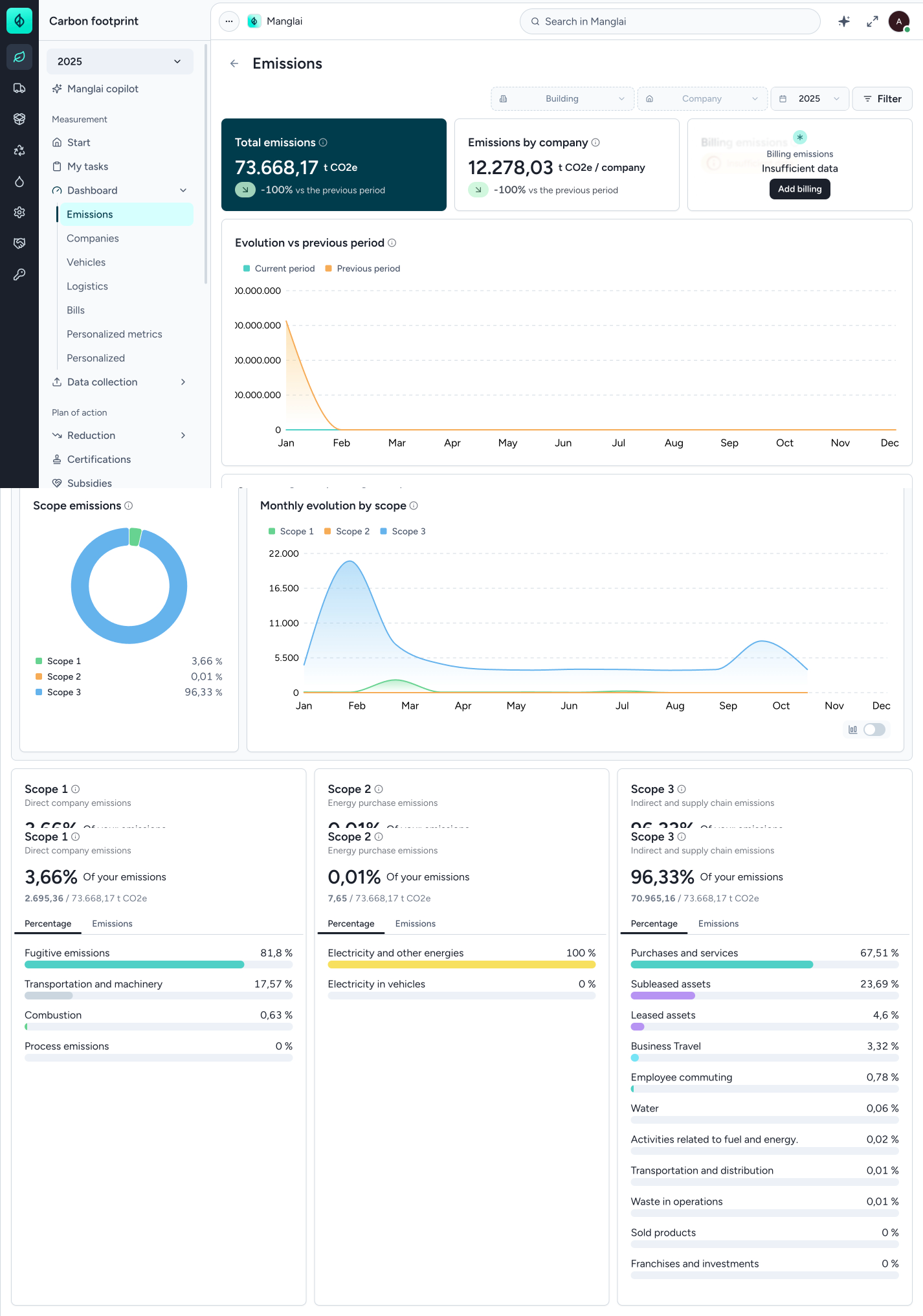
It integrates recognised factor databases including DEFRA, IPCC, IEA, Ecoinvent and MITECO national factors, and keeps every data point traceable back to its source document.
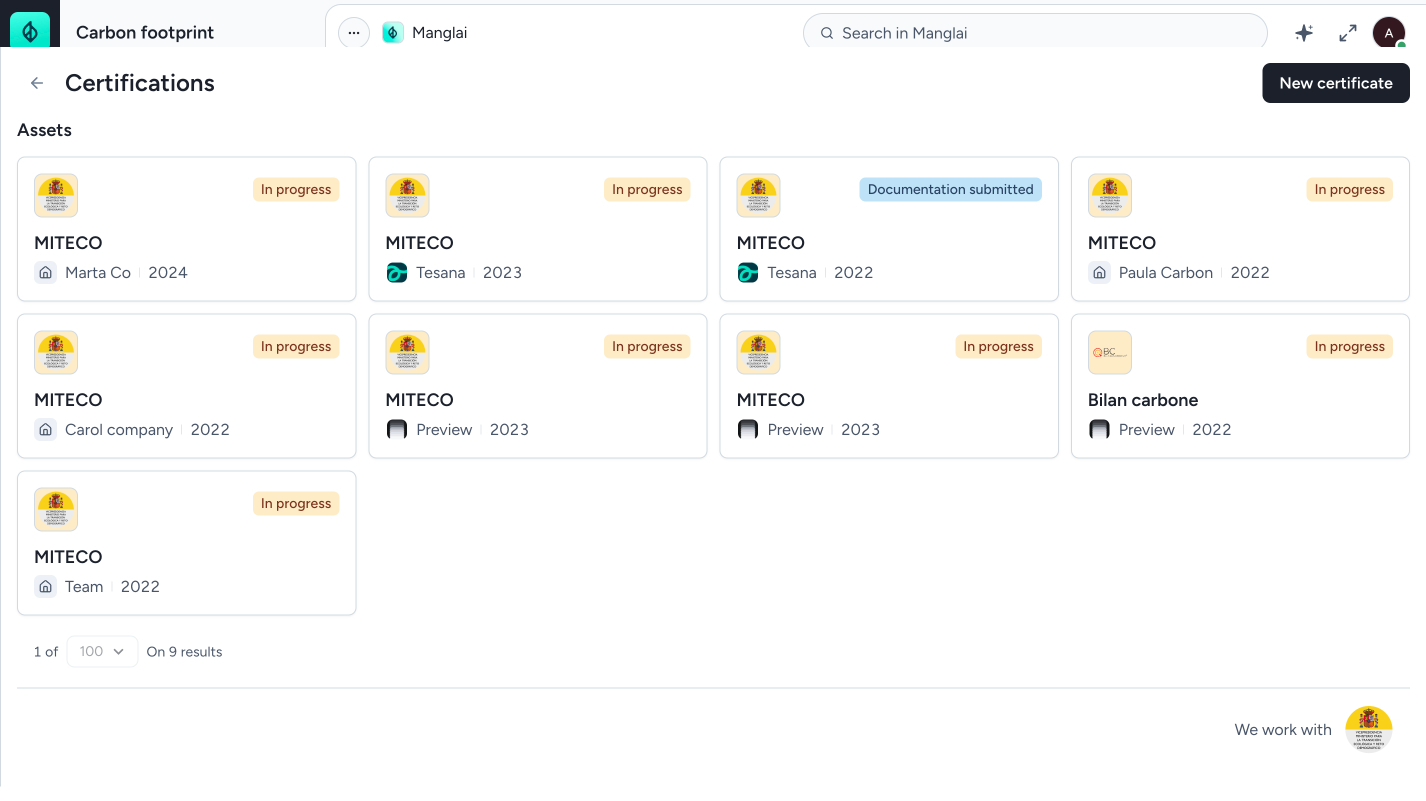
Strengths: it produces the calculation and the documentation for the registry and its three seals, keeps comparable series across reporting years, and offers a platform and support in Spanish. It is also an established solution, with active clients in 70 countries, more than 30,000 users and 25 million tonnes of CO2e managed, and an average rating of 4.7 out of 5.
Honest limitation: it does not replace an accredited verifier if your client or tender requires external verification under ISO 14064-3. You can see the exact scope in the Manglai MITECO solution.
2. SAP Sustainability Footprint Management
Aimed at large organisations already running SAP that want to calculate emissions from their own transactional data.
Strengths: native ERP integration, calculation by process and material, and strong scalability in complex structures.
Honest limitation: high cost and implementation effort, and no specific functionality for the Spanish registry file, which must be prepared separately.
3. Normative
A European carbon accounting platform focused on complete inventories and audit readiness.
Strengths: Scope 1, 2 and 3 coverage on the GHG Protocol, a broad emission factor base and a calculation engine independently assessed by TÜV SÜD against ISO 25051 and the GHG Protocol.
Honest limitation: English-only interface and no templates specific to the MITECO registry. It does not publish prices.
4. Greenly
A French solution aimed mainly at SMEs and mid-market companies starting to measure.
Strengths: fast onboarding, connection to accounting data and human support included in its plans.
Honest limitation: it does not publish rates, only three plan tiers, and the product is not localised into Spanish.
5. Plan A
A German platform focused on decarbonisation and corporate reporting.
Strengths: good support for SBTi targets and for the ESRS structure for companies within the CSRD perimeter.
Honest limitation: its value lies in European reporting, not in the Spanish registry procedure. It does not publish prices.
6. Persefoni
A carbon accounting platform with a strong financial orientation.
Strengths: audit-grade data approach, PCAF support for investment portfolios and a free Pro plan to get started.
Honest limitation: built for large organisations and the English-speaking market; it does not cover MITECO forms.
7. Sphera LCA for Experts (formerly GaBi)
A life cycle assessment suite, renamed from GaBi. It is a technical benchmark in industry.
Strengths: scientific rigour, very extensive databases and compatibility with multiple impact assessment methods.
Honest limitation: it solves product footprints, not corporate inventories. For the MITECO registry it works as support, not as the main tool.
8. openLCA
Open-source LCA software developed by GreenDelta.
Strengths: free, extensible and compatible with the main life cycle databases.
Honest limitation: it requires technical expertise, databases are licensed separately and it is not designed for the MITECO process.
Which software to choose for your situation
- An SME that only wants the Calculate seal: prioritise a guided workflow, built-in MITECO factors and automatic report generation. Manglai and Greenly fit this profile.
- A group with several sites: you need automatic consolidation and the ability to replicate the methodology year after year. Manglai, Normative and SAP are the realistic options.
- A company aiming for the Reduce seal: continuity is what matters. Check that the software preserves boundaries, factors and criteria between years so two three-year periods can be compared.
- A company that needs external verification: choose a tool that exports per-data-point evidence and full traceability. Verification is always carried out by an accredited third party.
- A company with ESG reporting duties on top of the registry: consider platforms that also cover the ESRS, such as Plan A or Normative, or a solution that produces both outputs.
- A technical team doing product LCA: Sphera LCA for Experts or openLCA, combined with a corporate tool for the inventory.
How to obtain the MITECO seal step by step
- Define the objective: only Calculate, a path towards Reduce, or offsetting as well. This determines how many years of data you need.
- Set the organisational boundary and document the consolidation approach.
- Collect activity data: electricity, fuels, fleet, business travel, refrigerants, waste and freight transport.
- Select emission factors for the reporting year and record their source.
- Calculate, review and compare the result against the previous year to spot anomalous jumps.
- Write the methodological report and the reduction plan and submit the file through the MITECO electronic office.
If you do not have a starting figure yet, you can get a quick estimate with the carbon footprint calculator for companies before deciding on a tool.
FAQs about software for MITECO certification
Is registering with MITECO mandatory?
Not for private companies: registration is voluntary. RD 214/2025 requires companies within its scope to calculate and publish their footprint and to have a reduction plan, and requires the central government administration to register from 2026.
Is there any MITECO-certified software?
No. The ministry validates submissions, not tools. What matters is that the calculation follows the GHG Protocol or ISO 14064-1 and that the documentation is traceable.
Do I need to measure Scope 3 to obtain the seal?
No. The minimum is Scopes 1 and 2. Scope 3 is optional and, if you choose to include it, the registry requires it to be verified by an accredited external body. It adds transparency and is increasingly requested in tenders and supply chains.
Can the seal be obtained without software?
Yes, using spreadsheets. The cost is time and risk: manual traceability is where rejections and incidents concentrate.
How many years of data do I need for the Reduce seal?
At least four years of comparable data, because two consecutive three-year periods are compared to demonstrate the downward trend.
Is external verification required?
For a Scope 1 and 2 submission using the registry's own factors, no. It is mandatory if you include Scope 3 or if you calculate significant emissions for which the registry does not publish factors. It also strengthens the credibility of the data, and many tenders and large clients ask for it. We explain it in our guide to carbon footprint certification in Spain.
If you want a broader comparison that is not limited to the Spanish registry, see our analysis of the best software to measure the carbon footprint, or look directly at how Manglai covers the full submission in its MITECO registry solution.
Paula Otero
Environmental and Sustainability Consultant
About the author
Biologist from the University of Santiago de Compostela with a Master’s degree in Natural Environment Management and Conservation from the University of Cádiz. After collaborating in university studies and working as an environmental consultant, I now apply my expertise at Manglai. I specialize in leading sustainability projects focused on the Sustainable Development Goals for companies. I advise clients on carbon footprint measurement and reduction, contribute to the development of our platform, and conduct internal training. My experience combines scientific rigor with practical applicability in the business sector.
Content
Companies that trust us















Practical guides
Spend-based vs activity-based method in scope 3: when to use each
The spend-based method calculates emissions for a scope 3 category by multiplying spend in currency by a sector-level monetary emission factor, while ...

Practical guides
Fluorinated gases and fugitive emissions: how to calculate scope 1 refrigerant leaks
Refrigerant leaks are usually the scope 1 line item that catches people off guard in a first greenhouse gas inventory: there is no fuel invoice behind ...

Practical guides
Carbon footprint of a services company: what to measure without a factory
With no factory or vehicle fleet of its own, the carbon footprint of a consultancy, a law firm, an agency or a software company concentrates in three ...
Guiding businesses towards net-zero emissions through AI-driven solutions.
Product & Pricing
What is Manglai
Features
SQAS
GLEC
GHG Protocol
ISO-14046
ISO-14064
Miteco certification
CSRD
CSDDD
Digital Product Passport
EINF
Prices
Customers
Partners
Solutions by role
Environmental consulting
ESG management solutions
Financial directors
General directors
HR managers
Operations directors
Quality and environment directors
Senior management
Solutions for investment funds
Supply chain managers
Sustainability managers
Transport responsible
© 2026 Manglai. All rights reserved