Practical guides
The 8 best ESG management software tools in 2026

Andrés Cester
CEO & Co-Founder

The best software tools for ESG management and for automating sustainability reporting in 2026 are Manglai, Workiva, Sphera Corporate Sustainability, Position Green, Datamaran, EcoVadis, IBM Envizi and Wolters Kluwer Enablon. Manglai leads the comparison for teams that need a traceable chain of evidence, from primary data through to the final report.
Every tool is compared on the same criteria: who it serves, which part of the ESG framework it genuinely covers, how it is deployed, whether it offers Spanish and local support, and what pricing it publishes as of August 2026.
Comparison of ESG management software
| Tool | Best for | ESG coverage | Deployment, language and support | Pricing |
|---|---|---|---|---|
| Manglai | Sustainability teams in SMEs and multi-site groups that need traceable reporting without a consultancy | Full environmental block: Scopes 1, 2 and 3 carbon, water footprint aligned with ISO 14046, waste with traceability by manager and treatment route, ESG matrices and ESRS E1, E2 and E5 export | SaaS with AI-assisted data capture. Platform and support in Spanish and English | Starter, Pro and Enterprise plans, no published rates |
| Workiva | Multinationals integrating finance, risk and sustainability in one environment | Connected financial and sustainability reporting, with version control, collaboration and audit traceability | SaaS. English interface with multilingual support | No public pricing |
| Sphera Corporate Sustainability | Industrial organisations with a strong environmental and safety component | Environmental accounting, risk, safety and compliance, with very broad impact libraries | SaaS. English interface | No public pricing |
| Position Green | European companies that want ESG reporting and carbon accounting in a single tool | ESRS, the voluntary standard, EU Taxonomy, SFDR, GRI, human rights due diligence and Scopes 1 to 3 carbon | Nordic SaaS. English and German interface | No public pricing |
| Datamaran | Teams that prioritise double materiality and regulatory monitoring | Automated materiality using text analytics, continuous regulatory monitoring and peer benchmarking | SaaS. English interface | No public pricing |
| EcoVadis | Companies with broad supply chains and heavy third-party dependence | Supplier assessments and ratings, plus a carbon module to drive upstream reduction | Assessment platform. Multilingual | No public pricing |
| IBM Envizi | Companies looking to connect ESG with operational systems, energy and IoT | ESG data, Scopes 1, 2 and 3 emissions, energy and utility analytics, decarbonisation planning | SaaS. Integration with the IBM and Microsoft ecosystems. English interface | No published rates, pricing depends on the volume of data managed |
| Wolters Kluwer Enablon | Organisations focused on compliance, health and safety | EHS and ESG suite with operational risk management and regulatory compliance | SaaS. English interface with a partner network | No public pricing |
Features and prices checked on each vendor's official website in August 2026. None of these platforms publishes fixed rates, so comparing cost means requesting quotes with identical scope from all of them.
What does ESG management software actually automate?
The phrase "automating ESG reporting" is used for very different things. It helps to separate what a platform solves on its own from what remains human work:
Genuinely automated:
- Data capture and normalisation: reading energy and fuel invoices, connecting to ERP, procurement or HR systems, and bulk loading from spreadsheets.
- Emission factor assignment and recalculation when those factors are updated.
- Validation rules: detecting gaps, anomalous jumps between periods, inconsistent units or duplicates.
- Multi-site consolidation and aggregation by legal entity, site or business unit.
- Report generation with indicators mapped to the standard and an audit trail showing which data feeds each figure.
Not automated:
- Materiality assessment. Monitoring tools can support it, but the company decides what is material and has to be able to defend it.
- Source data quality. If a supplier does not provide its consumption, no platform invents it. At best it estimates it and flags it as estimated.
- Narrative and policies: governance, action plans and targets still require judgement and writing.
- External assurance, which an accredited third party performs. Software only prepares the ground so it goes quickly.
The real return of an ESG platform is not "generating the report in one click". It is having the data in order all year, with linked evidence, instead of rebuilding it against the clock at closing.
What does ESG regulation require in 2026?
The framework changed substantially in 2026 and many companies are still working from 2024 assumptions:
- Directive (EU) 2026/470, published on 26 February 2026, the Omnibus package. It limits mandatory CSRD reporting to companies with more than 1,000 employees and over 450 million euros in turnover, for financial years starting on or after 1 January 2027. The transposition deadline is 19 March 2027. See the full analysis in our article on the Omnibus package.
- Revised ESRS, adopted by the Commission on 3 July 2026. They cut mandatory datapoints by more than 60% and total datapoints by more than 70%. They apply to financial years starting on or after 1 January 2027, with early application options for 2026. The practical steps are in our guide on how to implement the ESRS standards.
- The voluntary standard (VS), adopted on the same day, 3 July 2026, in a separate delegated act. It is the reference for companies outside the mandatory scope that still receive questionnaires from customers, banks or funds.
- Assurance: limited assurance remains mandatory and the move to reasonable assurance has been dropped. The limited assurance standard is due to be adopted by 1 July 2027.
- Value chain protection: companies with fewer than 1,000 employees may decline to provide information beyond what the voluntary standard requires.
The operational conclusion is that many SMEs leave the mandatory scope but not the demand. Reporting stops coming from the law and starts coming from the customer and the bank, which does not reduce the need to keep the data in order.
Which criteria should you use to choose ESG management software?
- Up-to-date regulatory alignment: the software should be mapped to the revised 2026 ESRS, the voluntary standard, the EU Taxonomy and the GHG Protocol, not to the 2023 version of the standards.
- Real domain coverage: carbon, water, waste, compliance, social indicators and governance. Fragmentation across tools is the leading cause of audit discrepancies.
- Traceability and evidence: every metric should carry its evidence, version history and automated validation rules. Without that, a review will not pass.
- Integration: ERP, IoT, HR systems, procurement platforms and environmental records, with connectors that are proven rather than promised.
- User experience: the easier it is to enter data, the higher the reporting quality. In ESG the bottleneck is almost always the person on site who has to upload a delivery note.
- Total cost: licence, implementation, internal hours and external assurance. Always request quotes with identical scope from every vendor.
If your specific priority is CSRD fit, we have a dedicated comparison of sustainability management software for CSRD.
Which is the best ESG management software?
1. Manglai
Best for: sustainability teams in SMEs and multi-site groups that need to report with full traceability and without relying on external consultancies.
Strengths: a complete chain of evidence, from primary data through to report generation, with an auditable workflow end to end.
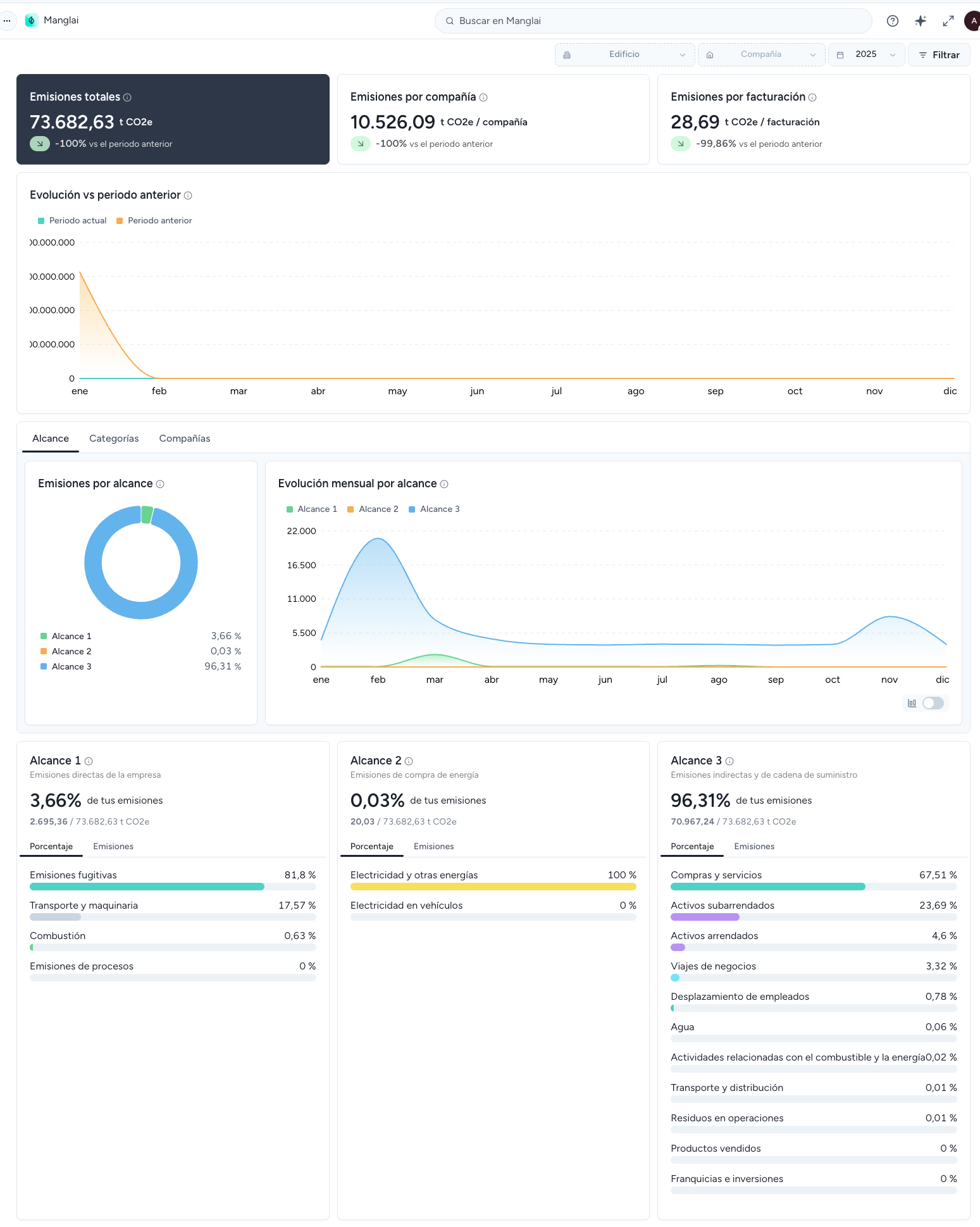
- Integrated carbon footprint, Scopes 1, 2 and 3, with deterministic calculation and a trace of every factor applied.
- Water footprint aligned with ISO 14046, including basin-level water risk.
- Waste module with traceability by authorised waste manager, waste code (EWC) and treatment route.
- ESG matrices prepared for internal and external audit.
- Automatic export of ESRS E1, E2 and E5.
- AI-assisted data capture, including automatic reading of utility invoices.
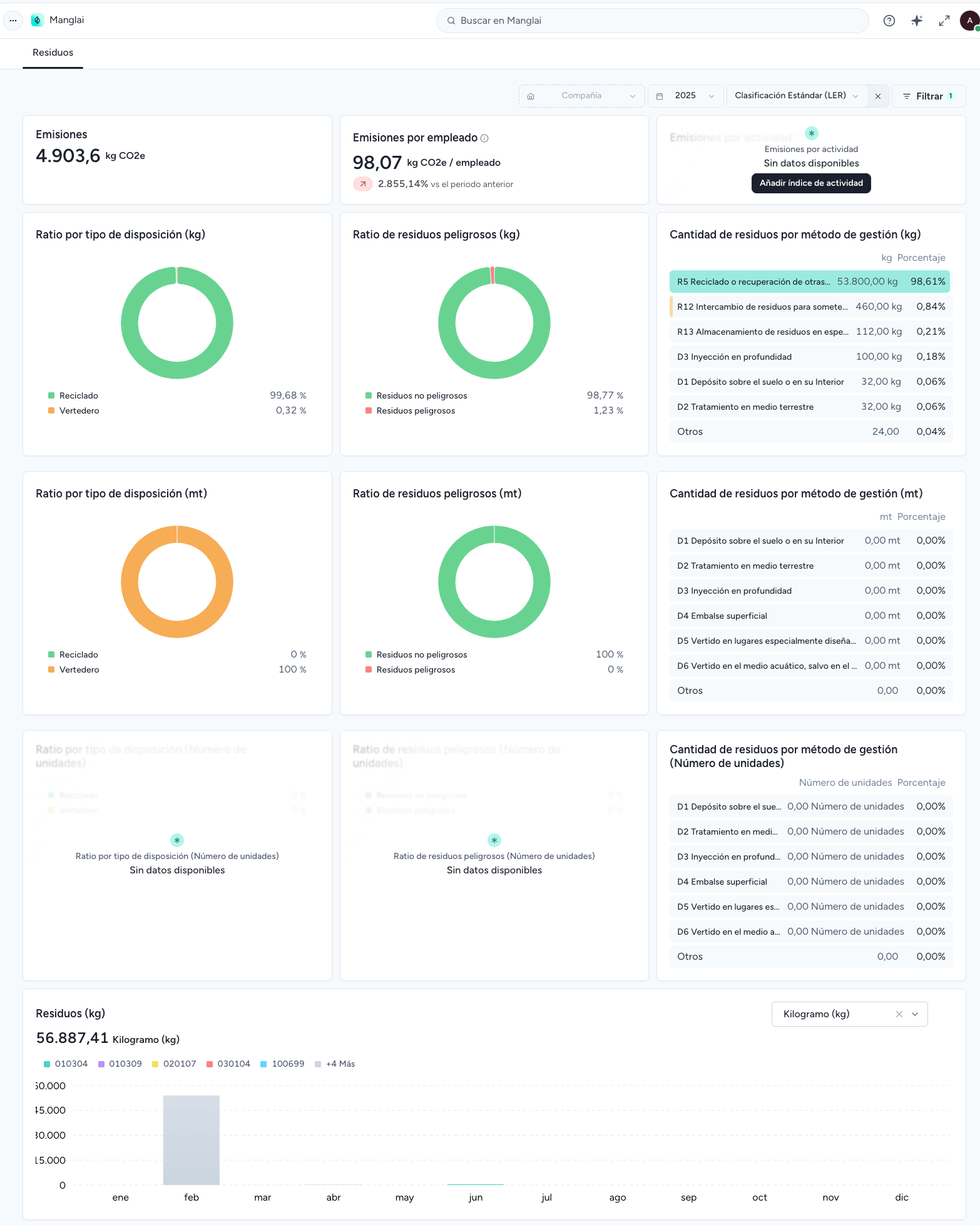
The proposition is backed by real traction: Manglai has active clients in 70 countries, more than 30,000 users and 25 million tonnes of CO2e managed, with an average rating of 4.7 out of 5.
Honest limitation: the depth sits in the environmental block. If your immediate priority is highly detailed social and governance indicators, validate the roadmap for those modules before deciding.
Pricing: Starter, Pro and Enterprise plans, no fixed rates published.
2. Workiva
Best for: multinationals that need the sustainability report and the financial report to come out of the same system.
Strengths: robust version control, real-time collaboration, figure linking across documents and an integration with internal audit that few platforms match.
Honest limitation: high cost and excessive complexity for small teams. It is a reporting tool, not an operational manager of plant-level environmental data.
Pricing: no public pricing.
3. Sphera Corporate Sustainability
Best for: industrial organisations that need advanced environmental methodologies alongside risk and safety management.
Strengths: technical rigour, very broad impact libraries and specialised modules for risk, safety and compliance.
Honest limitation: steep learning curve and a more technical than operational focus.
Pricing: no public pricing.
4. Position Green
Best for: European companies that want ESG reporting and carbon accounting in a single tool.
Strengths: broad coverage of European frameworks, including ESRS, the voluntary standard, the EU Taxonomy, SFDR, GRI and human rights due diligence, with carbon management across all three scopes and a supplier module.
Honest limitation: strong on reporting and lighter on operational plant-level environmental data, such as waste traceability by manager.
Pricing: no public pricing.
5. Datamaran
Best for: teams that prioritise double materiality and continuous regulatory monitoring.
Strengths: materiality analysis supported by text analytics over large volumes of information, tracking of regulation and stakeholder expectations, and peer benchmarking.
Honest limitation: it is not a comprehensive metrics platform. It works as a complement, not as a single reporting system.
Pricing: no public pricing.
6. EcoVadis
Best for: companies with broad supply chains that need to assess third parties on consistent criteria.
Strengths: standardised assessments, comparability across suppliers and a carbon module to drive upstream reduction.
Honest limitation: it is built for rating third parties, not for internal corporate reporting. It does not replace a platform for managing your own data.
Pricing: no public pricing.
7. IBM Envizi
Best for: companies that want to integrate ESG with operational systems, energy and IoT.
Strengths: solid emissions and energy analytics, decarbonisation planning with target tracking, and integration with the IBM and Microsoft ecosystems.
Honest limitation: less specialised in waste and social indicators than in energy and emissions.
Pricing: no published rates. Pricing is based on the volume of data managed and is scoped during the sales process.
8. Wolters Kluwer Enablon
Best for: organisations with a strong compliance, health and safety focus that want to add the ESG block to what they already run.
Strengths: very mature operational risk management and a comprehensive EHS suite.
Honest limitation: complex implementation and a typical dependency on consulting to get full value.
Pricing: no public pricing.
Which ESG software should you choose for your case?
- SME receiving ESG questionnaires from customers or its bank: Manglai, for entry cost and full environmental coverage without needing a consultancy.
- Multi-site group consolidating several legal entities: Manglai or Position Green, prioritising automatic consolidation and per-site access control.
- Listed company integrating financial and sustainability reporting: Workiva.
- Industry with operational risk and safety obligations: Sphera Corporate Sustainability or Wolters Kluwer Enablon.
- Your problem is the supply chain: EcoVadis to assess suppliers, combined with a platform for your own data.
- You need to defend a materiality assessment to an auditor: Datamaran as documentary support.
- Your priority is energy and decarbonisation with sensor data: IBM Envizi.
- You only need carbon, water or waste: look at the dedicated comparisons of carbon footprint software, water footprint software and waste footprint software before buying a full suite.
How to automate ESG reporting step by step
- Define the scope: which legal entities, which sites and which period. A poorly defined scope invalidates year-on-year comparison from day one.
- Select material indicators: with the revised 2026 ESRS, the mandatory list is far shorter. Focusing on what is material saves half the work.
- Map the origin of each datapoint: who generates it, which system it lives in, how often it updates and who validates it. This step decides whether automation works.
- Connect what is already digital first: energy invoices, procurement and payroll. Leave whatever still lives on paper for later.
- Configure validation rules and alert thresholds before loading history, not after.
- Run a first iteration with two or three months of data and measure errors, gaps and time spent. It is the only honest way to estimate the real saving.
- Scale to the rest of the system and set a monthly or quarterly closing cadence. A dashboard is only useful if it refreshes at the pace decisions are made, as we explain in our guide to sustainability indicators and KPIs.
If your organisation wants to move from spreadsheets to a traceable ESG system, see how Manglai handles it in its software for ESG managers and its CSRD reporting solution.
FAQs about ESG management software
Am I still required to report under CSRD in 2026?
Only if you exceed the thresholds in Directive (EU) 2026/470: more than 1,000 employees and over 450 million euros in turnover. The first reports under the new scope cover financial years starting on or after 1 January 2027.
What do I report if my company falls outside the mandatory scope?
The voluntary standard adopted on 3 July 2026 is the reference. It is designed so an SME can answer customers, banks and funds without taking on the full ESRS burden.
How much time does automating ESG reporting save?
It depends on the starting point and how much data already sits in digital systems. The reliable saving is not in generating the document, it is in not rebuilding the data at every close. Before signing, ask the vendor to prove it on your own data in a two or three month pilot.
Does ESG software replace a consultancy?
It substantially reduces dependence on the calculation, consolidation and report generation side. It does not replace expert judgement on materiality, strategy or the relationship with the assurance provider.
Can I use several tools at once?
Yes, but every boundary between systems is a potential discrepancy. If you keep several, define from the start which one is the single source of truth for each indicator.
What do assurance providers ask for that almost nobody has ready?
The evidence behind each figure and the change log: who modified which datapoint, when and why. It is the first thing reviewed and the last thing that tends to be ready.
Andrés Cester
CEO & Co-Founder
About the author
Andrés Cester is the CEO of Manglai, a company he co-founded in 2023. Before embarking on this project, he was co-founder and co-CEO of Colvin, where he gained experience in leadership roles by combining his entrepreneurial vision with the management of multidisciplinary teams. He leads Manglai’s strategic direction by developing artificial intelligence-based solutions to help companies optimize their processes and reduce their environmental impact.
Content
Companies that trust us
















Practical guides
Spend-based vs activity-based method in scope 3: when to use each
The spend-based method calculates emissions for a scope 3 category by multiplying spend in currency by a sector-level monetary emission factor, while ...

Practical guides
Fluorinated gases and fugitive emissions: how to calculate scope 1 refrigerant leaks
Refrigerant leaks are usually the scope 1 line item that catches people off guard in a first greenhouse gas inventory: there is no fuel invoice behind ...
Practical guides
Carbon footprint of a services company: what to measure without a factory
With no factory or vehicle fleet of its own, the carbon footprint of a consultancy, a law firm, an agency or a software company concentrates in three ...
Guiding businesses towards net-zero emissions through AI-driven solutions.
Product & Pricing
What is Manglai
Features
SQAS
GLEC
GHG Protocol
ISO-14046
ISO-14064
Miteco certification
CSRD
CSDDD
Digital Product Passport
EINF
Prices
Customers
Partners
Solutions by role
Environmental consulting
ESG management solutions
Financial directors
General directors
HR managers
Operations directors
Quality and environment directors
Senior management
Solutions for investment funds
Supply chain managers
Sustainability managers
Transport responsible
© 2026 Manglai. All rights reserved