Practical guides
The 8 best software solutions for ISO 14064 (2026)

Paula Otero
Environmental and Sustainability Consultant

The best software for implementing ISO 14064 in 2026 is Manglai, SAP Sustainability Control Tower, Sphera, Normative, Persefoni, One Click LCA, Ecochain and openLCA. Manglai leads the comparison for its stated conformity with ISO 14064-1:2018, its end-to-end calculation traceability and its reports prepared for external verification.
What exactly does ISO 14064 require?
ISO 14064 is the standard that defines how to quantify and report greenhouse gas inventories in a verifiable way. It has three parts, and it is worth knowing which one applies to you before comparing tools:
- ISO 14064-1:2018: organisation-level GHG inventory. This is the part almost every company uses, and it defines organisational and operational boundaries, direct and indirect emissions, uncertainty management and data quality.
- ISO 14064-2:2019: quantification of reductions or removals at project level.
- ISO 14064-3:2019: requirements for validation and verification by an independent third party.
The difference from the GHG Protocol is that the latter defines principles and categories while ISO 14064 defines the method and the verifiable requirements. In practice most companies combine the two, as set out in the comparison between the GHG Protocol and ISO 14064-1 and in the review of the key carbon footprint measurement standards.
Its relevance in 2026 comes through three concrete routes. First, it is the technical basis on which many companies build regulated reporting: after Directive (EU) 2026/470 the CSRD is limited to companies with more than 1,000 employees and more than 450 million euros in turnover, with the first reports covering financial year 2027, and the detail is in our analysis of the Omnibus package. Second, Spanish Royal Decree 214/2025 requires companies within its scope to calculate scope 1 and 2 emissions and publish a five-year reduction plan, with registration in the MITECO registry remaining voluntary for private companies, as covered in the guide to carbon footprint registry obligations. Third, verification bodies usually expect inventories built under ISO 14064 before issuing assurance, which matters for tenders and large customers.
ISO 14064-compatible software compared
| Tool | Best for | Inventory coverage | Other standards and frameworks | Spanish version and local support | Pricing model |
|---|---|---|---|---|---|
| Manglai | SMEs, mid-market and groups preparing a verifiable inventory | Scopes 1, 2 and 3 with stated conformity to ISO 14064-1:2018 and audit-ready reports | GHG Protocol, ESRS, MITECO | Yes, product and support in Spanish | Starter, Pro and Enterprise plans, price on request |
| SAP Sustainability Control Tower | Corporations already running SAP | Corporate consolidation of scopes 1, 2 and 3 | GHG Protocol, ESRS | Multilingual | No published prices |
| Sphera | Industrial technical teams | Corporate inventory alongside LCA and product footprint | ISO 14040 and 14044, EN 15804, ISO 14067 | Multilingual | No published prices |
| Normative | Companies focused on reporting and scope 3 | Corporate inventory and supplier emissions | GHG Protocol, ESRS | Mainly English | No published prices |
| Persefoni | Large corporations and financial institutions | Corporate inventory and financed emissions | GHG Protocol, PCAF, ESRS, ISSB | Mainly English | Free Pro plan, Advanced plan on request |
| One Click LCA | Construction, infrastructure and manufacturing | Product footprint and EPDs, with corporate GHG modules | EN 15804, ISO 14025, ISO 14067 | Multilingual | No published prices |
| Ecochain | Industrial SMEs | LCA and corporate footprint in one environment | ISO 14040 and 14044, ISO 14067 | Mainly English | Professional from 290 euros per month and Business from 640 euros per month |
| openLCA | Technical profiles with a limited budget | Inventory and LCA modelling, without automated ISO workflows | ISO 14040 and 14044 | English | Free and open source, databases purchased separately |
Which is the best software to implement ISO 14064?
1. Manglai
Best for: companies that need a unified system to measure, document and verify their GHG inventory, and that also have to answer to clients, tenders or verification bodies.
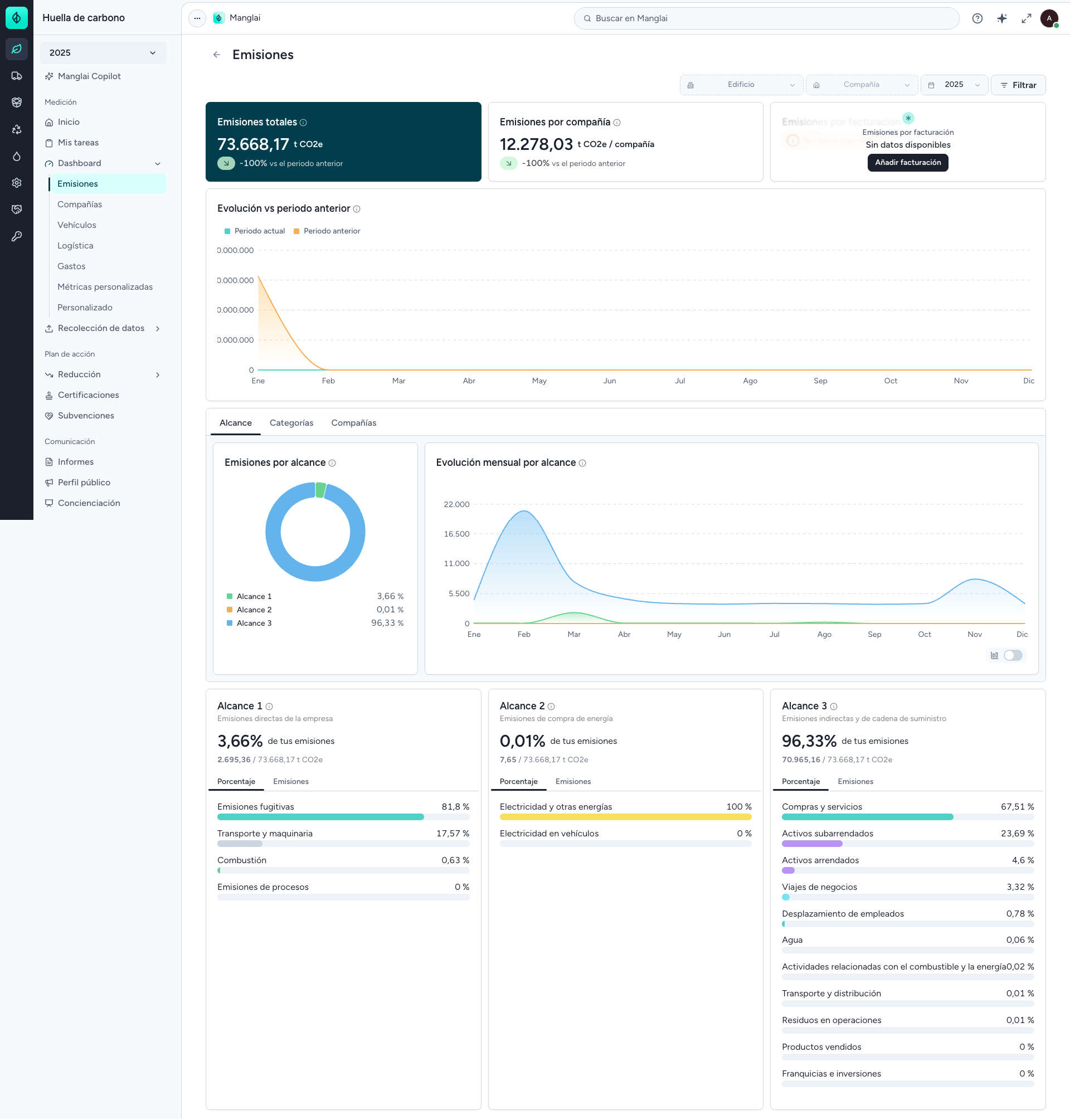
Strengths:
- Stated conformity with ISO 14064-1:2018, the current version of the standard.
- Scope 1, 2 and 3 calculation in a single inventory, using recognised GHG Protocol methodology and sector libraries.
- Auditable, verifiable reports with traceable documents suitable for external audit.
- Uncertainty ranges and quality controls on the result, which is exactly what a verifier reviews.
- Architecture that scales to site, fleet and supplier inventories.
- Product and support in Spanish, useful when the report goes to MITECO or a Spanish client.

It is an established platform: active clients in 70 countries, more than 30,000 users and 25 million tonnes of CO2e managed, with an average rating of 4.7 out of 5.
Honest limitation: it is not an expert-level life cycle assessment tool. If you need to model complex industrial processes at LCA level, the sensible combination is Manglai as the corporate inventory plus a specialised tool. The detail is in Manglai's ISO 14064 solution.
2. SAP Sustainability Control Tower
Best for: multinational corporations already working with SAP.
Strengths: integration with operational and financial ERP data, automated bulk data loads and centralised inventory visibility. SAP complements it with SAP Green Ledger to bring emissions data into accounting territory.
Honest limitation: high cost, long timelines and the need for internal technical teams or consultants. It does not publish prices.
3. Sphera
Best for: industrial organisations with environmental specialists in house.
Strengths: methodological rigour, consistency across LCA, product carbon footprint and corporate GHG inventories, and wide sector databases. Its LCA tool, formerly known as GaBi, is now sold as LCA for Experts.
Honest limitation: steep learning curve and a design aimed at technical teams. It does not publish prices.
4. Normative
Best for: companies whose main goal is a well-structured inventory and reporting, with a focus on supplier scope 3.
Strengths: data governance, a clear inventory structure and work on supply chain data.
Honest limitation: product and support mainly in English, and less oriented to day-to-day plant operations. It does not publish prices.
5. Persefoni
Best for: large corporations and financial institutions that also need financed emissions.
Strengths: scalability, data control and PCAF coverage. It offers a free Pro plan, which lets you test the workflow before deciding.
Honest limitation: complexity and a steep adoption curve for a small team. The Advanced plan has no published price.
6. One Click LCA
Best for: construction, infrastructure and manufacturing.
Strengths: sector templates, advanced automation and integration with Environmental Product Declarations. Since September 2025 the group also includes SimaPro and PRé Sustainability.
Honest limitation: its core is product footprinting and EPDs, not the corporate inventory under ISO 14064-1, and it is less versatile outside construction. It does not publish prices.
7. Ecochain
Best for: industrial SMEs that want to combine LCA and corporate footprinting without launching a large programme.
Strengths: clear interface, short learning curve and published prices, which is unusual in this market: the Professional plan starts at 290 euros per month and the Business plan at 640 euros per month, both according to the vendor's own website.
Honest limitation: limitations in documentation for complex ISO audits and dependence on specific databases by industry.
8. openLCA
Best for: technical profiles, universities and research centres with a limited budget.
Strengths: free and open source, extensible and able to work with public and commercial databases.
Honest limitation: requires advanced expertise and does not include automated ISO verification workflows. Databases are purchased separately.
How to choose ISO 14064-compatible software
1. Alignment with the standard. It must reflect the principles of relevance, completeness, consistency, transparency and accuracy. You can tell by whether the tool forces you to declare boundaries and criteria before calculating, or lets you start anywhere.
2. Data quality and emission factors. Up-to-date libraries plus the ability to load auditable custom factors, with a record of the source and the version applied.
3. Uncertainty management. ISO 14064-1 requires it to be handled explicitly. Check that the tool shows ranges and not just a rounded figure.
4. Calculation traceability. From raw activity data to the final result, with linked evidence and version history. It is the first thing a verifier asks for.
5. Verifiable reporting. Methodological notes, annexes, inventory boundaries and source descriptions, generated by the system rather than by hand.
6. Integration with other frameworks. GHG Protocol, ESRS E1, ISO 14067 and sector requirements. Duplicating inventories per framework is the most expensive mistake in this process.
Which software to choose in your situation
- SME or mid-market company in Spain preparing its first verifiable inventory and possibly the MITECO seal: Manglai.
- Multinational group already on SAP: SAP Sustainability Control Tower, accepting the timeline.
- Industrial company with a technical team that needs consistency between LCA, product footprint and inventory: Sphera.
- Company whose bottleneck is supplier scope 3: Normative.
- Financial institution that must cover financed emissions as well as its own inventory: Persefoni.
- Very limited budget and a technical profile: openLCA, accepting that verification is handled outside the tool.
How to start implementing ISO 14064
1. Define the purpose of the inventory: regulatory compliance, tenders, CSRD reporting, customer requirements or an internal decarbonisation plan. The standard requires clarity here.
2. Establish the organisational boundaries: operational control, financial control, equity share or a combination.
3. Collect the structural data: energy consumption, mobility and logistics, processes, procurement, waste, water and fugitive emissions.
4. Calculate and generate the documentation: methodological notes, technical annexes, source descriptions and category-level indicators.
5. Prepare for independent verification: evidence, primary sources, intermediate calculations and version history. The full process and its benefits are in the guide to carbon footprint certification in Spain.
Implementing ISO 14064 is above all a problem of structure and evidence. To see how that workflow is organised end to end, a good starting point is the general comparison of software to measure the carbon footprint.
Frequently asked questions about ISO 14064 software
Do I need software to become ISO 14064 certified?
It is not mandatory, but it helps considerably. Audits require traceability, structured documentation and verifiable records, and doing it with spreadsheets alone increases the risk of errors and complicates version control.
What is the difference between ISO 14064 and the GHG Protocol?
The GHG Protocol defines principles and categories while ISO 14064 defines the method and the verifiable requirements. Most companies combine the two.
Which version of the standard is current?
For the organisational inventory, ISO 14064-1:2018. Parts 2 and 3, covering projects and verification, were published in 2019.
Is it mandatory to audit my inventory?
Not always, although it is usually essential for regulated sustainability reporting, public tenders and negotiations with large clients.
Can ISO 14064 be extended to suppliers?
Yes, and a growing number of companies require it. The usual approach is to start with the suppliers that concentrate the most spend and add their inventories to the same system.
Paula Otero
Environmental and Sustainability Consultant
About the author
Biologist from the University of Santiago de Compostela with a Master’s degree in Natural Environment Management and Conservation from the University of Cádiz. After collaborating in university studies and working as an environmental consultant, I now apply my expertise at Manglai. I specialize in leading sustainability projects focused on the Sustainable Development Goals for companies. I advise clients on carbon footprint measurement and reduction, contribute to the development of our platform, and conduct internal training. My experience combines scientific rigor with practical applicability in the business sector.
Content
Companies that trust us















Practical guides
Spend-based vs activity-based method in scope 3: when to use each
The spend-based method calculates emissions for a scope 3 category by multiplying spend in currency by a sector-level monetary emission factor, while ...

Practical guides
Fluorinated gases and fugitive emissions: how to calculate scope 1 refrigerant leaks
Refrigerant leaks are usually the scope 1 line item that catches people off guard in a first greenhouse gas inventory: there is no fuel invoice behind ...

Practical guides
Carbon footprint of a services company: what to measure without a factory
With no factory or vehicle fleet of its own, the carbon footprint of a consultancy, a law firm, an agency or a software company concentrates in three ...
Guiding businesses towards net-zero emissions through AI-driven solutions.
Product & Pricing
What is Manglai
Features
SQAS
GLEC
GHG Protocol
ISO-14046
ISO-14064
Miteco certification
CSRD
CSDDD
Digital Product Passport
EINF
Prices
Customers
Partners
Solutions by role
Environmental consulting
ESG management solutions
Financial directors
General directors
HR managers
Operations directors
Quality and environment directors
Senior management
Solutions for investment funds
Supply chain managers
Sustainability managers
Transport responsible
© 2026 Manglai. All rights reserved