Practical guides
The 6 best water footprint software tools for packaging in 2026

Carolina Skarupa
Product Carbon Footprint Analyst

The most relevant tools for calculating and managing the water footprint in a packaging company are Manglai, Waterplan, SimaPro, Sphera LCA for Experts, Ecochain and openLCA. Manglai fits best in multi-plant environments that need continuous measurement and reporting; the LCA suites fit better when the goal is a detailed product study or an environmental declaration.
Before comparing, one criterion is worth fixing: in packaging, most of the water impact is not at the plant tap but upstream, in the production of paper, cardboard and polymers. A tool that only reads your own meters will give you a small and not very useful figure.
Water footprint software comparison for packaging
| Tool | Who it is for | What it solves in packaging | Multi-plant and automation | Pricing model |
|---|---|---|---|---|
| Manglai | Multi-plant manufacturers that need continuous management | Corporate and per-plant water footprint, integrated with carbon, waste and energy | Yes, with automatic reading of consumption invoices | Price on request |
| Waterplan | International groups with plants in stressed basins | Site-level water risk, targets and stewardship projects | Yes, with consumption anomaly detection | Does not publish prices |
| SimaPro (One Click LCA group) | Consultancies and technical departments | Full packaging LCA with water scarcity methods such as AWARE | No, works study by study | Does not publish prices |
| Sphera LCA for Experts (formerly GaBi) | Large paper and polymer industry | Fine-grained modelling of production processes and raw materials | No, works study by study | Licence on request |
| Ecochain | Manufacturers with wide product catalogues | Automated product LCA and EPD generation | Partial, product oriented | Publishes prices, from 290 euros per month |
| openLCA | Technical teams on a tight budget | Custom packaging LCA with external databases | No, manual configuration | Free and open source |
Why does packaging have a specific water problem?
The sector combines three factors that make the calculation harder:
- Water-intensive raw materials. Paper and cardboard production needs water in pulping and sheet forming, and polymers carry water impacts from their upstream chain.
- Geographic spread. A group with plants in several basins has very different impacts for the same volume consumed, because the characterisation factor depends on local availability.
- Administrative data volume. Water invoices, meter readings, discharge records and process data per line, multiplied by the number of plants.
That is why the water footprint in packaging is not solved with an annual spreadsheet: it needs a single data source and a methodology that stays stable between reporting years.
Which regulation applies to water in packaging in 2026?
- ISO 14046:2014. The international technical reference for assessing the water footprint with a life cycle approach, and still the current version of the standard. See the definition in our ISO 14046 entry.
- CSRD and ESRS E3. Companies within the CSRD perimeter must report water-related impacts, risks and opportunities through the ESRS E3 topical standard, part of the European Sustainability Reporting Standards. After the Omnibus package and Directive (EU) 2026/470, the perimeter has been reduced to companies with more than 1,000 employees and more than 450 million euros in turnover, with first reports covering financial year 2027. The revised ESRS, adopted in July 2026, also cut the number of mandatory datapoints substantially.
- PPWR, Regulation (EU) 2025/40. It applies from 12 August 2026. It does not regulate water, but it does require documenting the composition, recyclability and recycled content of every packaging item. That per-reference material inventory is exactly what you need to calculate the water footprint of the packaging, so it is worth building it once. We cover it in our guide to the PPWR becoming mandatory in August 2026.
Beyond regulation, the real pressure usually comes from clients: large retailers and consumer goods brands ask for environmental data per packaging reference, and increasingly for the water breakdown as well.
How to choose water footprint software for packaging
- Alignment with ISO 14046 and the ability to apply regionalised scarcity factors rather than a single global factor.
- Modelling of real industrial operations: differentiating paper, cardboard and plastic, and allocating consumption by line or plant.
- Automated data capture. Across a network of ten plants, manual invoice uploading is the bottleneck that turns the calculation into a one-off exercise.
- Supply chain: the ability to incorporate raw material and supplier data, which is where most of the impact sits.
- Usability for the internal team. If only an external consultant can run it, it is not a management tool.
- Traceability and auditability: every figure linked to its invoice or record, with a date and an owner.
- Actionable output: prioritisation by plant, process and material, not just an annual total.
Which is the best water footprint software for packaging companies?
1. Manglai
Manglai is designed for industrial companies and packaging manufacturers that need to calculate and manage their water footprint without adding technical complexity to daily operations. It fits particularly well in multi-plant organisations that want to integrate water management into standard processes without relying on external consultants for every update.
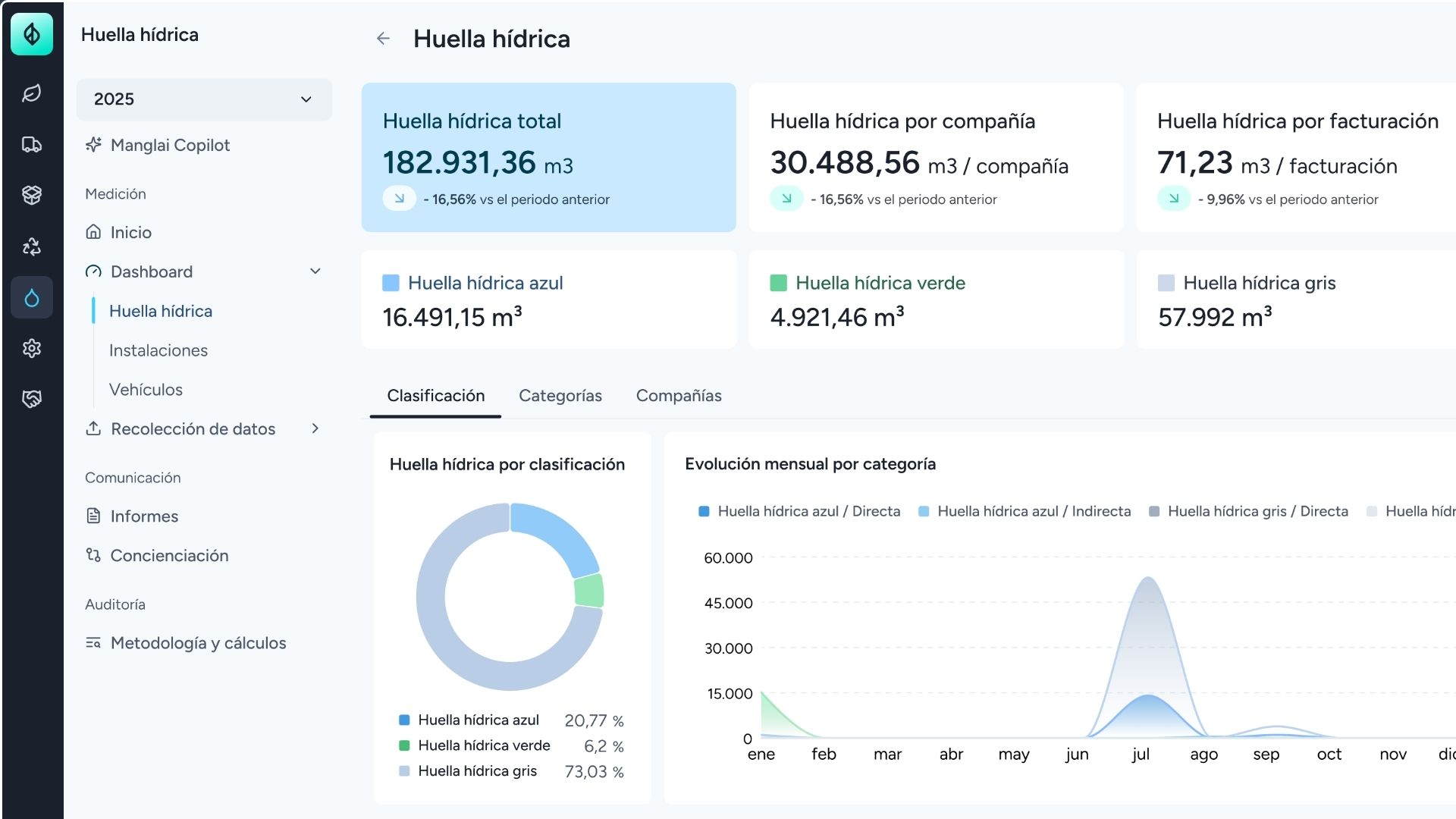
Strengths:
- Intelligent import of data and invoices with automatic reading and classification, which is what makes the calculation viable across a plant network.
- Manglai Copilot, which analyses the environmental data loaded into the platform and detects anomalies and patterns, with natural language queries about which plant, process or material concentrates the impact.
- Water footprint integrated with carbon, waste and energy within the same boundary, with reports ready for verification and ESG disclosure.
- Breakdown by plant and process, which allows investment prioritisation rather than a single total.
- An established platform: active clients in 70 countries, more than 30,000 users and 25 million tonnes of CO2e managed, with an average rating of 4.7 out of 5.
Honest limitation: if you need to model unit processes one by one for a peer-reviewed comparative LCA study, you will still need a specialised LCA suite.
2. Waterplan
A corporate platform centred on water, focused on managing water risk at site level. It is useful when your problem is not only calculating but understanding each plant's exposure to water stress and planning mitigation.
Strengths: local water data per site, target tracking and consumption anomaly detection.
Honest limitation: it is not a life cycle assessment tool, so on its own it does not deliver an ISO 14046 water footprint study or the raw material impact. It does not publish prices.
3. SimaPro
An LCA tool created by PRé Sustainability and part of One Click LCA since September 2025, widely used in environmental consultancies and industrial technical departments.
Strengths: methodological transparency, broad database compatibility and support for regionalised water scarcity methods such as AWARE.
Honest limitation: it works study by study rather than as continuous management, and the learning curve is steep. It does not publish prices.
4. Sphera LCA for Experts (formerly GaBi)
The suite known for years as GaBi, now LCA for Experts. It is the reference option when you need detailed modelling of pulping, papermaking or polymerisation processes.
Strengths: very extensive proprietary databases and fine control over process parameters.
Honest limitation: it requires an expert profile and an investment only justified by a high volume of studies.
5. Ecochain
LCA automation software for manufacturers, built to calculate product footprints at scale and generate environmental declarations.
Strengths: suitable when you have hundreds of packaging references and clients asking for EPDs or product footprints per SKU, with built-in hotspot analysis and published prices.
Honest limitation: its focus is the product. It does not cover the corporate water inventory per plant or site-level water risk.
6. openLCA
Open-source LCA software from GreenDelta.
Strengths: free, flexible and compatible with the main international databases.
Honest limitation: manual configuration, separately licensed databases and no multi-plant management features.
To these six it is worth adding a free source that is not management software but that almost every project uses: the World Resources Institute Aqueduct Water Risk Atlas, which publishes global water risk indicators including baseline water stress, so you can place each plant in its basin.
What to choose for your case
- A single plant and a first calculation: start with an estimate using the water footprint calculator and decide afterwards whether you need a platform.
- A network of plants across several countries: prioritise data automation and consolidation. Manglai for measurement and reporting, Waterplan when local water risk is the dominant problem.
- Your client asks for EPDs or per-reference footprints: Ecochain or SimaPro, depending on whether you need scale or depth.
- You are going to publish a comparative study: an LCA suite plus review by an accredited third party. No management platform replaces that review.
- You are inside the CSRD perimeter: water data needs to sit alongside the other indicators within the same organisational boundary, not in a separate file.
How to start managing the water footprint in your packaging company
- Define the objective: ESRS E3 compliance, answering a client, reducing water stress risk or improving efficiency. Each calls for a different level of detail.
- Select a pilot plant that is representative by volume or location and validate the approach before scaling.
- Gather the essential data: withdrawal, consumption, discharge, processes and critical raw materials. Consistency matters more than initial perfection.
- Place each plant in its basin using a water stress indicator and apply regionalised factors.
- Run a first measurement as a baseline and identify critical points by plant, process and material.
- Scale progressively to the rest of the network, keeping the same methodology so the series stay comparable.
If you want the detail of the calculation method, we develop it in our guide on how to measure the corporate water footprint.
Frequently asked questions about water footprint software in packaging
Is calculating the water footprint mandatory?
There is no general obligation to calculate it under ISO 14046. There is an obligation to report water-related impacts, risks and opportunities for companies within the CSRD perimeter, through ESRS E3.
Does the PPWR require water measurement?
No. The PPWR regulates packaging and packaging waste, not water. What it does require is per-reference material data, which is the basis for the packaging water calculation.
Can it be calculated without supplier data?
Yes, using secondary data from life cycle databases. You lose precision and auditability, and in packaging that matters because most of the impact sits in raw materials.
Are water footprint and water consumption the same thing?
No. Consumption measures volumes; the water footprint assesses the impact of that use taking local availability and the full life cycle into account.
How long does a first measurement take?
It depends on data availability. With a pilot plant and accessible invoices, a baseline within weeks is realistic; with an international network and scattered data, the timeline stretches.
Is a water risk tool enough for ESRS E3?
It helps on the risk side, but the standard also asks for consumption and impact metrics, so it usually needs to be combined with a measurement platform.
If your priority is to stop treating water as an annual exercise and turn it into industrial management data, see how the Manglai water footprint module handles it, or review our general water footprint software comparison if packaging is not your sector.
Carolina Skarupa
Product Carbon Footprint Analyst
About the author
Graduated in Industrial Engineering and Management from the Karlsruhe Institute of Technology, with a master’s degree in Environmental Management and Conservation from the University of Cádiz. I'm a Product Carbon Footprint Analyst at Manglai, advising clients on measuring their carbon footprint. I specialize in developing programs aimed at the Sustainable Development Goals for companies. My commitment to environmental preservation is key to the implementation of action plans within the corporate sector.
Content
Companies that trust us















Practical guides
Spend-based vs activity-based method in scope 3: when to use each
The spend-based method calculates emissions for a scope 3 category by multiplying spend in currency by a sector-level monetary emission factor, while ...

Practical guides
Fluorinated gases and fugitive emissions: how to calculate scope 1 refrigerant leaks
Refrigerant leaks are usually the scope 1 line item that catches people off guard in a first greenhouse gas inventory: there is no fuel invoice behind ...

Practical guides
Carbon footprint of a services company: what to measure without a factory
With no factory or vehicle fleet of its own, the carbon footprint of a consultancy, a law firm, an agency or a software company concentrates in three ...
Guiding businesses towards net-zero emissions through AI-driven solutions.
Product & Pricing
What is Manglai
Features
SQAS
GLEC
GHG Protocol
ISO-14046
ISO-14064
Miteco certification
CSRD
CSDDD
Digital Product Passport
EINF
Prices
Customers
Partners
Solutions by role
Environmental consulting
ESG management solutions
Financial directors
General directors
HR managers
Operations directors
Quality and environment directors
Senior management
Solutions for investment funds
Supply chain managers
Sustainability managers
Transport responsible
© 2026 Manglai. All rights reserved