Carbon accounting is the systematic process of measuring, calculating and recording the greenhouse gas emissions associated with an organisation, an activity or a product. Its output is a quantified inventory, usually expressed in tonnes of CO2 equivalent, that underpins reporting, target setting and reduction decisions.
Unlike financial accounting, which records economic flows in a currency, carbon accounting records physical flows of emissions. It does, however, share principles such as relevance, completeness, consistency, transparency and accuracy, which is why many companies embed it in their management and reporting systems.
What it relies on: standards and frameworks
Carbon accounting is not improvised: it follows internationally recognised methodologies. The two main references are the GHG Protocol (Greenhouse Gas Protocol), the most widely used framework for corporate inventories, and the ISO 14064 family of standards, whose part 1 sets requirements for designing and reporting an organisation-level inventory, part 2 covers reduction projects and part 3 covers the verification of assertions.
Both frameworks are compatible and often used together: the GHG Protocol provides the methodological guidance and ISO 14064 offers a third-party verifiable specification.
The components of an inventory
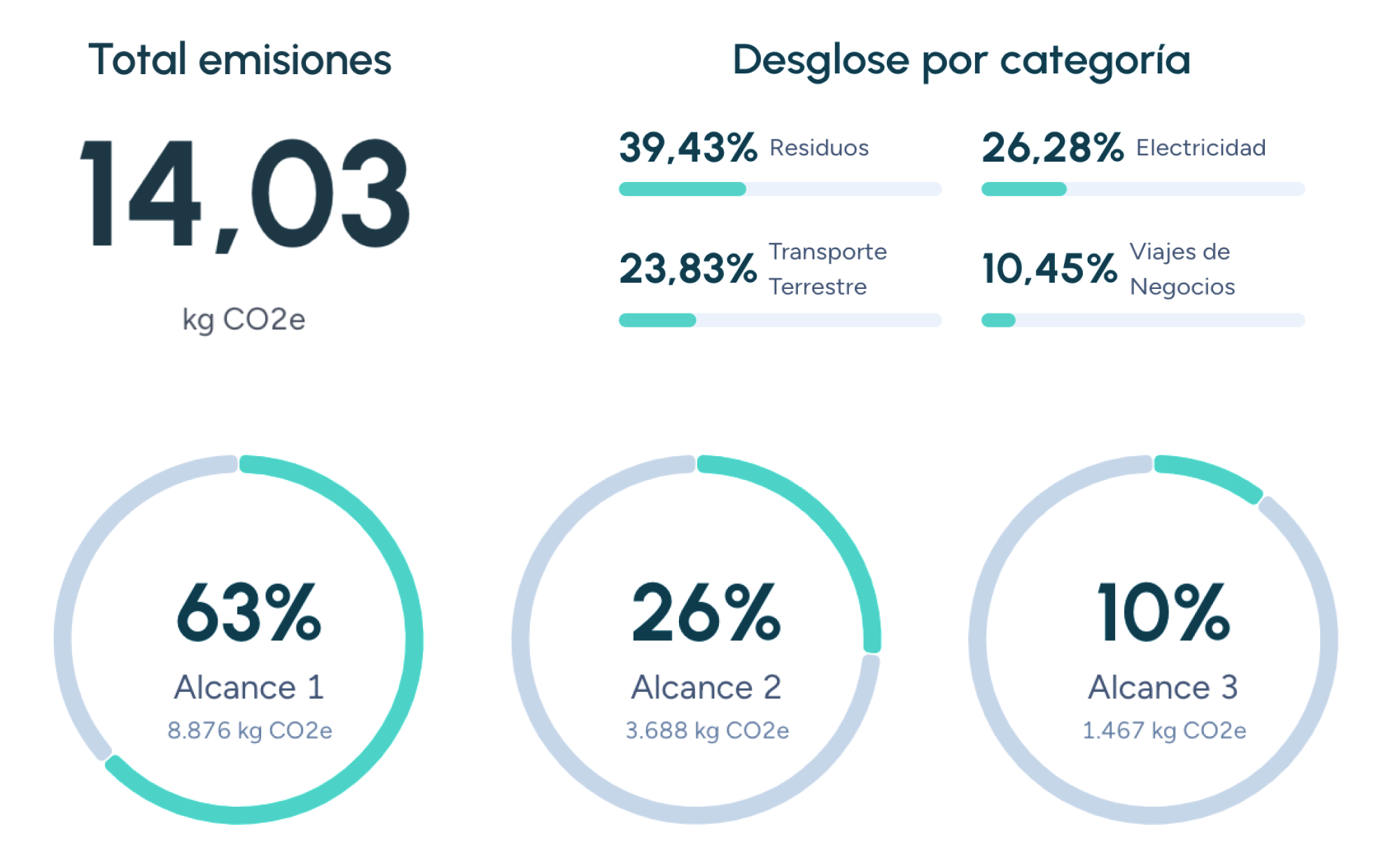
A complete carbon account organises emissions into three scopes:
- Scope 1 emissions, direct, from owned or controlled sources such as boilers, furnaces or fleet.
- Scope 2 emissions, indirect, from purchased electricity, heat or steam.
- Scope 3 emissions, the remaining indirect value-chain emissions, usually the largest and hardest to measure.
To turn activity data (litres of fuel, kWh, kilometres, kilograms of material) into emissions, you apply emission factors. The whole calculation is consolidated into an emissions inventory, referenced to a base year that acts as the starting point for tracking progress over time.
What it is used for
Carbon accounting is the foundation of almost everything else in climate management. Without a reliable inventory you cannot calculate a carbon footprint, set credible targets or communicate progress without risking greenwashing. Its main uses are:
- Regulatory and voluntary reporting: it feeds sustainability reports and disclosure frameworks.
- Target setting: it provides the baseline against which reduction goals are defined.
- Carbon markets: it quantifies the emissions an organisation seeks to reduce and, where relevant, offset.
Data quality and verification
The value of carbon accounting depends on data quality. Good practice requires documenting sources, assumptions and inventory boundaries, and keeping methodological consistency between periods so that comparisons remain valid. Independent verification, in line with ISO 14064-3, strengthens the credibility of the information and is increasingly common across reporting frameworks.
Measure your carbon with Manglai
Rigorous carbon accounting is the first step of any serious decarbonisation strategy. Manglai helps you measure, calculate and record your scope 1, 2 and 3 emissions in a traceable, audit-ready way. Discover how Manglai can help you build a reliable inventory and keep it up to date.
Companies that trust us















Related terms
See all termsCarbon audit
A carbon audit is the structured process of measuring, analysing and verifying an organization's greenhouse gas emissions across Scopes 1, 2 and 3, expressed in CO2e.
Carbon budget
The carbon budget is the total amount of CO2 that can still be emitted while keeping global warming below a set limit, such as 1.5°C above pre-industrial levels.
Carbon footprint monitoring
Carbon footprint monitoring is the ongoing tracking of an organisation's GHG emissions. We explain why it matters and how the PDCA cycle drives continuous improvement.
Guiding businesses towards net-zero emissions through AI-driven solutions.
Product & Pricing
What is Manglai
Features
SQAS
GLEC
GHG Protocol
ISO-14046
ISO-14064
Miteco certification
CSRD
CSDDD
Digital Product Passport
EINF
Prices
Customers
Partners
Solutions by role
Environmental consulting
ESG management solutions
Financial directors
General directors
HR managers
Operations directors
Quality and environment directors
Senior management
Solutions for investment funds
Supply chain managers
Sustainability managers
Transport responsible
© 2026 Manglai. All rights reserved