Practical guides
INFO Murcia Sustainability Cheque: the CHIS grants for SMEs

Carolina Skarupa
Product Carbon Footprint Analyst

The Sustainability Cheque (Cheque Sostenibilidad) run by the Institute for Development of the Region of Murcia (INFO) is a grant scheme that helps small and medium-sized enterprises in this Spanish region pay for specialist services in carbon footprint, water footprint and sustainability reporting. Its aim is to strengthen competitiveness and support companies through the transition towards more efficient business models that are better prepared for environmental regulation.
Important note on timing: the Sustainability Cheque runs through periodic calls with a limited budget. The 2025 call was open until 5 January 2026 and no longer accepts applications. Before planning a project, check the call currently in force and the up-to-date amounts on the INFO electronic office, because the terms can change from one year to the next.
What is the INFO Murcia Sustainability Cheque?
The Sustainability Cheque is an INFO grant programme designed to boost business innovation and competitiveness by funding the purchase of specialist sustainability services. It is intended to encourage the reduction of greenhouse gas (GHG) emissions, improve resource efficiency and prepare SMEs for the demands of the green transition.
The grants are aimed at SMEs based or operating in the Region of Murcia and are organised into several lines known as CHIS (Cheque Innovación Sostenibilidad). Each line funds a specific type of service.
What are the Sustainability Cheque grant lines?
According to the most recent published call, the grants are structured into the following types. Confirm the active lines and their amounts in the call currently in force, as they may be updated.
CHIS 1: organisational carbon footprint
- Purpose: calculating the carbon footprint of the company or organisation.
- Applicable standards: ISO 14064 and the GHG Protocol.
- Indicative maximum grant: up to 5,000 euros.
CHIS 2: product carbon footprint
- Purpose: calculating the carbon footprint of a product across its life cycle.
- Applicable standards: ISO 14067, PAS 2050 and the GHG Protocol.
- Indicative maximum grant: up to 5,000 euros.
CHIS 3: water footprint
- Purpose: calculating the water footprint of a company or product.
- Applicable standards: ISO 14046 and the Water Footprint Network methodology.
- Indicative maximum grant: up to 5,000 euros.
CHIS 4: sustainability report
- Purpose: preparing sustainability reports or statements in line with the CSRD and the ESRS.
- Applicable standards: ESRS, GRI, IFRS S and SASB.
- Indicative maximum grant: up to 7,500 euros.
Every action must form part of the company's corporate social responsibility (CSR) strategy and help improve its competitive position.
CHIS 1: why calculate your organisation's carbon footprint?
CHIS 1 funds the calculation of the corporate carbon footprint, which measures the direct and indirect emissions generated by a company across its operations.
Business benefits
- It lets you define a reduction plan and cut energy use through efficiency measures.
- It improves access to public tenders with environmental criteria.
- It makes registration in MITECO's carbon footprint registry easier.
The calculation must include a reduction plan and follow recognised standards such as ISO 14064 or the GHG Protocol, covering at least Scopes 1 and 2 (direct emissions and indirect emissions from energy).
Indicative grant amount
- One part for the calculation and registration with MITECO.
- An additional amount if a verification body is engaged.
- Indicative maximum: 5,000 euros per company.
Regulatory context: Royal Decree 214/2025
It helps to place this line within the framework of Royal Decree 214/2025, which creates the state carbon footprint registry and, crucially, establishes the obligation for certain companies (with more than 250 employees, or exceeding 20 million euros in assets or 40 million euros in turnover) to calculate and publish their carbon footprint and a reduction plan, with Scopes 1 and 2 mandatory and Scope 3 voluntary. Registration with MITECO remains voluntary for private companies. Calculating the footprint with support from the Sustainability Cheque helps SMEs get ahead of these requirements and of those that reach them through the supply chain.
CHIS 2: product carbon footprint, added value for your brand
CHIS 2 supports the calculation of the product carbon footprint, an essential tool for measuring environmental impact across the whole product life cycle, from raw material extraction to disposal or recycling.
Business advantages
- It lets you compare products and processes using objective metrics.
- It reinforces transparency with customers and suppliers.
- It supports obtaining environmental certifications and eco-labels.
The calculation should follow standards such as ISO 14067 or PAS 2050. For products in specific sectors (wine, for example) there are also dedicated sectoral methodologies.
Indicative grant amount
- One part for the product calculation.
- An additional amount for external verification.
- Indicative maximum: 5,000 euros.
CHIS 3: what is the water footprint and why measure it?
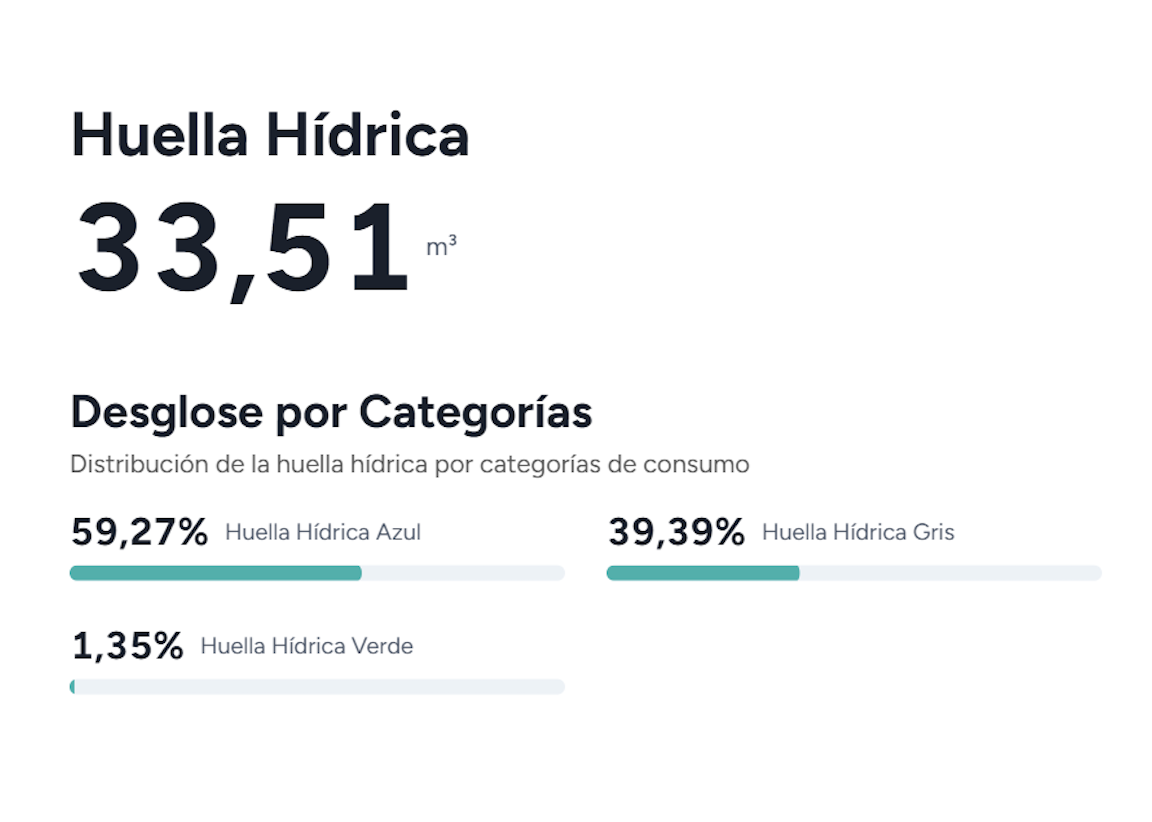
CHIS 3 funds the calculation of the water footprint, which indicates how much water is used to make a product or deliver a service and how that affects the availability of the resource.
In a region under water stress like Murcia, this calculation is a strategic tool for keeping operations sustainable.
Main benefits
- It identifies the critical points of water consumption across the value chain.
- It enables water reuse or recirculation systems.
- It reduces the costs and risks linked to water scarcity.
The assessment should follow ISO 14046 or the Water Footprint Network (WFN) methodology.
Indicative grant amount
- One part for the calculation.
- An additional amount for verification.
- Indicative maximum: 5,000 euros.
CHIS 4: a sustainability report aligned with the CSRD
CHIS 4 funds the preparation of sustainability reports or statements under the CSRD (Directive 2022/2464) and the European Sustainability Reporting Standards (ESRS).
Contents of the report
- Sustainable strategy and business model.
- ESG policies and targets (environmental, social and governance).
- Quantitative indicators of environmental and social impact.
- Assessment of climate and transition risks.
The scope of the CSRD was changed by the 2025 Omnibus simplification package, which delayed and narrowed reporting obligations for part of the corporate universe. It is therefore worth confirming case by case whether your company falls within scope and on what timeline. You can read more in our guide on the CSRD and its cascade effect on SMEs' supply chains.
Indicative grant amount
- One part for producing the report.
- An additional amount if it includes external verification.
- Indicative maximum: 7,500 euros.
Grant intensity and general conditions
According to the latest call, the grant intensity starts from a base percentage of eligible costs, with an additional uplift for projects aligned with the RIS4 Strategy of the Region of Murcia 2021-2027. Consultancy services, verification, registration in official registries and the production of ESG reports are eligible. The exact percentages and limits are set in each call, so they should be checked in the terms currently in force.
Who can apply for the Sustainability Cheque?
In general terms, the beneficiaries can be SMEs in the Region of Murcia that:
- Are legally constituted and active.
- Carry out their economic activity in Murcia.
- Are not in difficulty or subject to penalties.
- Meet the specific requirements of the CHIS line applied for (for example, in CHIS 1, not having already registered a footprint with the same or wider scope).
How and when to apply
The procedure is online, through the INFO electronic office. Grants are usually resolved on a first-come, first-served basis until the available budget is exhausted, so it is best to apply as early as possible within the deadline.
Deadlines: these are whatever the call in force sets. For reference, the 2025 call opened on 19 March 2025 and closed on 5 January 2026, with a documentation deadline of 31 December 2025. For the current dates, check the INFO website.
Usual documentation
- Project description.
- Service quote.
- Responsible declaration.
- Certificates of being up to date with the tax authority and Social Security.
Frequently asked questions about the INFO Murcia Sustainability Cheque
Is the call open right now?
The 2025 call closed on 5 January 2026. INFO tends to renew grants of this kind, so it is worth checking its electronic office periodically to see whether a new call is open and on what terms.
What is the difference between an organisational and a product carbon footprint?
The organisational footprint measures all the emissions generated by the company as a whole, whereas the product footprint analyses those associated with a specific good or service.
Can I apply for more than one CHIS line?
Generally yes, as long as they are different actions and the requirements of each line are met. Confirm this point in the terms of the call in force.
Is external verification compulsory?
It usually is not, but it increases the grant amount and adds technical credibility to the result.
Can large companies apply?
No. The programme is aimed at SMEs in the Region of Murcia.
Conclusion
The INFO Murcia Sustainability Cheque is an opportunity for SMEs to measure their environmental footprint and prepare for regulation with public support. Because it works through calls, the recommendation is to have the project defined so you can submit it as soon as the next one opens. If you want to calculate your carbon or water footprint with auditable, registration-ready data, you can rely on Manglai's carbon footprint platform.
Carolina Skarupa
Product Carbon Footprint Analyst
About the author
Graduated in Industrial Engineering and Management from the Karlsruhe Institute of Technology, with a master’s degree in Environmental Management and Conservation from the University of Cádiz. I'm a Product Carbon Footprint Analyst at Manglai, advising clients on measuring their carbon footprint. I specialize in developing programs aimed at the Sustainable Development Goals for companies. My commitment to environmental preservation is key to the implementation of action plans within the corporate sector.
Content
Companies that trust us



















Practical guides
Carbon footprint of a services company: what to measure without a factory
With no factory or vehicle fleet of its own, the carbon footprint of a consultancy, a law firm, an agency or a software company concentrates in three ...

Practical guides
Limited assurance of the sustainability report: what the verifier reviews and how to prepare
Assurance over the CSRD sustainability report is, and will remain, limited assurance . Directive (EU) 2026/470 removed the planned move to reasonable ...

Practical guides
MITECO emission factors in 2026: which version to use and how to apply them
Spain's Ministry for the Ecological Transition, MITECO, publishes its emission factors in early May each year , and the rule for using them is simple: ...
Guiding businesses towards net-zero emissions through AI-driven solutions.
Product & Pricing
What is Manglai
Features
SQAS
GLEC
GHG Protocol
ISO-14046
ISO-14064
Miteco certification
CSRD
CSDDD
Digital Product Passport
EINF
Prices
Customers
Partners
Solutions by role
Environmental consulting
ESG management solutions
Financial directors
General directors
HR managers
Operations directors
Quality and environment directors
Senior management
Solutions for investment funds
Supply chain managers
Sustainability managers
Transport responsible
© 2026 Manglai. All rights reserved