The best software tools for calculating emissions under the GLEC Framework in 2026 are Manglai, EcoTransIT World, BigMile, Searoutes, Blue Yonder Logistics Emissions Calculator (formerly Pledge), SAP Sustainability Footprint Management, Sphera LCA for Experts and openLCA. Manglai leads the comparison when you need logistics emissions inside the same inventory as your corporate and product footprint.
Every tool is compared on the same criteria: who it serves, which transport modes it covers, which standards and accreditations it holds, how it is deployed and what pricing it publishes as of August 2026.
Comparison of software for calculating emissions under the GLEC Framework
| Tool | Best for | Coverage and modes | Standards and accreditation | Deployment, language and pricing |
|---|---|---|---|---|
| Manglai | SMEs and groups that need logistics emissions inside their corporate and product inventory | Multimodal by route, shipment, product and service, integrated with Scope 3 | GLEC Framework, ISO 14083, GHG Protocol, ISO 14064-1, ESRS E1 | SaaS with AI-assisted data capture, platform and support in Spanish and English. Starter, Pro and Enterprise plans, no published rates |
| EcoTransIT World (IVE mbH) | Shippers and operators that need scientific multimodal calculation with built-in routing | Road, sea, air, rail and inland waterway | ISO 14083 certified and GLEC Framework, compatible with the GHG Protocol. It was the first GLEC-accredited tool | Web and API. English interface. No public pricing |
| BigMile | Shippers, carriers and logistics operators that want analysis by customer, route and vehicle | Road and multimodal logistics chain | ISO 14083:2023 verified, GLEC Framework as its emission factor source, CountEmissions EU, ISAE 3000 Type 2 and SOC 2 | Dutch SaaS. English interface. Pricing on request |
| Searoutes | Teams that want to embed the calculation via API, with an ocean focus | Maritime and routing, with vessel tracking | ISO 14083 certified, Smart Freight Centre accredited models, GLEC methods | API-first platform. English interface. No rates published openly |
| Blue Yonder Logistics Emissions Calculator | Freight forwarders and operators that issue emissions reports to their customers | Multimodal freight transport | Smart Freight Centre GLEC Framework and ISO 14083 | SaaS integrated into the Blue Yonder platform after the 2025 acquisition. English interface. From USD 150 per month |
| SAP Sustainability Footprint Management | Corporations already running on SAP | Transport inside the corporate and product calculation | GHG Protocol, Scopes 1, 2 and 3, cradle-to-grave product footprint | SaaS with native SAP S/4HANA Cloud integration. Multilingual. No public pricing |
| Sphera LCA for Experts (formerly GaBi) | LCA teams that model transport as one more life cycle stage | Transport as a process inside the LCA, not as a logistics network | Multi-criteria LCA, EPD, PCF | Expert software with over 20,000 DEKRA-verified datasets and a 45-day trial. English. No public pricing |
| openLCA | Technical and academic teams on a limited budget | Transport modelled manually inside the LCA | LCA, EN 15804, Environmental Footprint | Free software from GreenDelta. English. Free, databases licensed separately |
Data checked on each vendor's official website in August 2026. The last three tools in the table are not logistics emissions software in the strict sense: they are included because many companies calculate transport inside their ERP or their life cycle model.
What is the GLEC Framework and which version applies in 2026?
The GLEC Framework (Global Logistics Emissions Council), developed by the Smart Freight Centre, is the international reference method for calculating and reporting greenhouse gas emissions from freight transport.
The current version is GLEC Framework 3.2, published on 23 October 2025. It keeps full alignment with ISO 14083:2023, the international standard for quantifying and reporting greenhouse gas emissions of transport chain operations, and adds a new air pollutant module covering particulate matter, nitrogen oxides, sulphur oxides and black carbon alongside CO2 equivalent.
Unlike corporate approaches, the GLEC Framework is organised around logistics flows rather than the organisation, and covers road, sea, air, rail and intermodal transport, including transhipment and storage hubs. Its goal is that the same shipment produces the same result regardless of who calculates it, provided the same data and assumptions are used.
It serves three profiles: manufacturers that need to trace the footprint to the final customer, logistics operators that must report emissions to their clients, and companies with reduction targets that include their Scope 3. You can find the methodological detail in our guide to the GLEC Framework applied to logistics emissions.
What changes with CountEmissions EU in 2026?
Regulation (EU) 2026/1030 of 29 April 2026 on the greenhouse gas emissions accounting of transport services, known as CountEmissions EU, was published in the Official Journal on 12 May 2026 and entered into force on 1 June 2026.
Three points matter:
- It does not require you to calculate. The regulation does not oblige companies to measure or publish transport emissions. What it does is set how they must be calculated and communicated when a company chooses to do so for commercial purposes, when a contract demands it, or when another EU or national rule imposes it, so that figures become comparable across providers.
- It builds on EN ISO 14083:2023, the same methodological base as the GLEC Framework. If your tool already meets GLEC and ISO 14083, the step is about data governance, not method.
- Rollout is progressive. Technical detail arrives through delegated and implementing acts, and the regulation's obligations do not apply until 2 December 2030.
The practical effect is that large shippers will start asking carriers for data calculated under this framework long before that date, as already happens with Scope 3. If your problem is fleet operations rather than the calculation framework, see our comparison of logistics carbon footprint software.
Which criteria should you use to choose GLEC calculation software?
- Accredited methodology, not just claimed: check whether the vendor holds ISO 14083 certification or Smart Freight Centre accreditation, or simply states GLEC compatibility.
- Real multimodal coverage: road, sea, air, rail and intermodal, including transhipment hubs. Many tools handle one mode well and estimate the rest.
- Data hierarchy: the tool should let you use actual fuel consumption where it exists and fall back to default values only when there is no data, making clear which level was used on each leg.
- Integration: import from ERP, TMS, telematics systems or spreadsheets, with traceability of origin.
- Reporting: dashboards and exports compatible with European reporting requirements, CDP and science-based targets, plus reports by customer or route.
- Total cost: licence, implementation, maintenance and internal hours. Almost no vendor in this market publishes rates, so compare quotes with identical scope.
Which is the best software for calculating emissions under the GLEC Framework?
1. Manglai
Best for: companies that need transport emissions inside the same system that already holds their corporate and product footprint, without standing up a separate tool just for logistics.
Strengths: integrates recognised methodologies, including the GLEC Framework, to calculate emissions by product, service or logistics route with full traceability. It compares transport and material scenarios and generates reporting aligned with European standards and science-based targets. Platform and support available in Spanish and English.
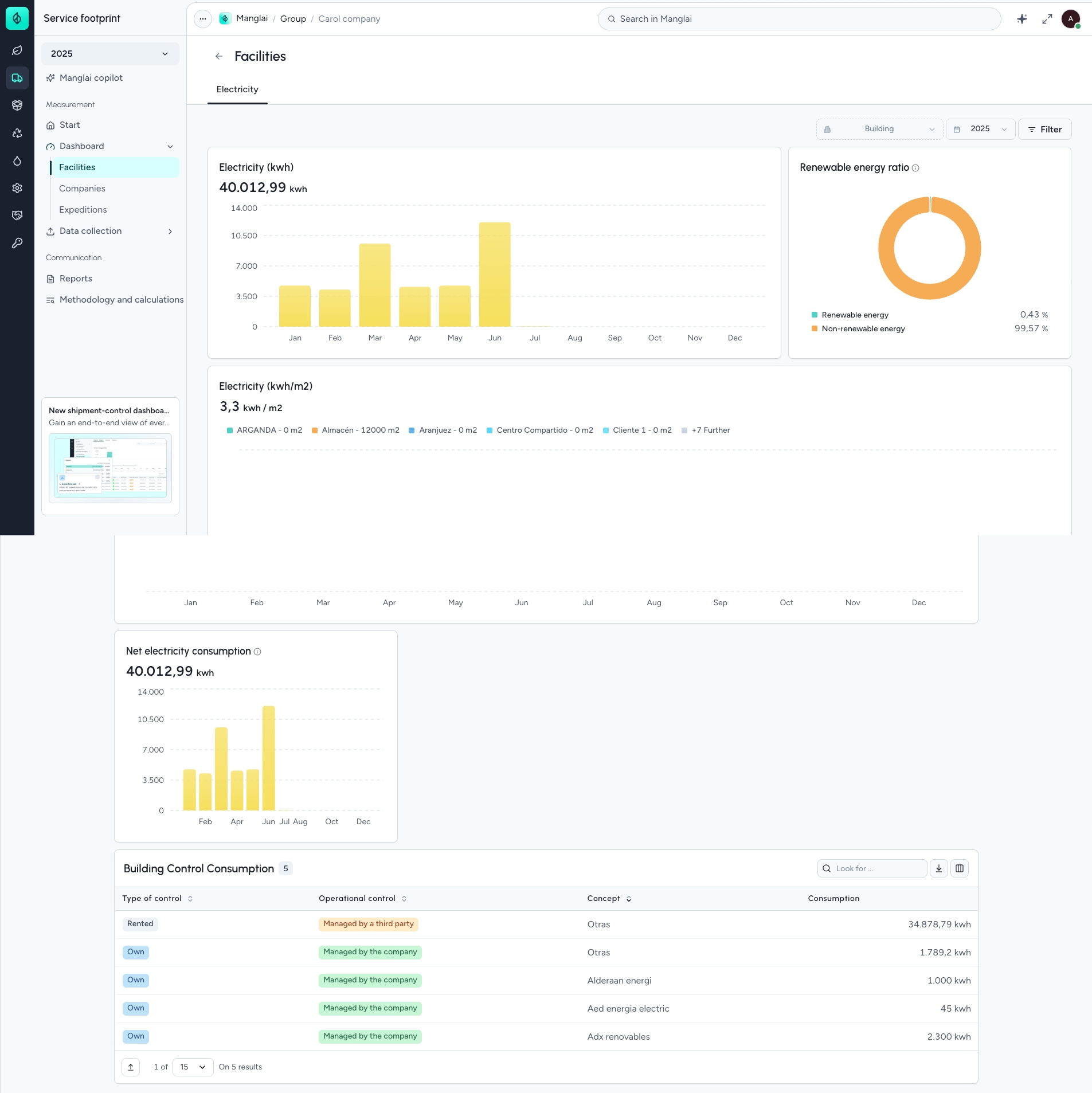

The proposition is backed by real traction: Manglai has active clients in 70 countries, more than 30,000 users and 25 million tonnes of CO2e managed, with an average rating of 4.7 out of 5.
Honest limitation: it is not a routing tool. If you need door-to-door distance calculation with a proprietary routing engine and vessel tracking, a specialist tool such as EcoTransIT World or Searoutes covers that better.
Pricing: Starter, Pro and Enterprise plans, no fixed rates published.
You can see how it is applied in the Manglai GLEC solution.
2. EcoTransIT World
Best for: shippers and operators that need multimodal calculation on a scientific basis with integrated routing.
Strengths: certified to ISO 14083 and the GLEC Framework, and the first tool ever GLEC-accredited. Its methodology was developed by independent scientific institutes (ifeu, INFRAS and Fraunhofer IML) with an energy-based bottom-up approach. Operated by IVE mbH, it covers truck, ship, aircraft, train and inland vessel with its own routing. Available as a web application and as an API.
Honest limitation: it is a transport calculation engine, not an environmental management platform. It will not solve your corporate inventory or your sustainability report.
Pricing: no public pricing.
3. BigMile
Best for: shippers, carriers and logistics operators that need to allocate emissions by customer, route, vehicle or shipment.
Strengths: one of the few platforms that explicitly states alignment with ISO 14083:2023, the GLEC Framework and CountEmissions EU at the same time, with ISAE 3000 Type 2 and SOC 2 accreditations that ease external review. Its strength is allocation analytics, which is exactly what an operator needs to answer its customers.
Honest limitation: it is heavily centred on the Dutch market and on road transport. English interface.
Pricing: no published rates, pricing on request, with special conditions for members of certain sector associations.
4. Searoutes
Best for: technical teams that want to embed emissions calculation into their own systems through an API, with an ocean focus.
Strengths: ISO 14083 certification and Smart Freight Centre accredited models, using GLEC methods. It combines maritime routing with vessel tracking, which moves you from theoretical distance to the route actually sailed.
Honest limitation: coverage is heavily skewed toward maritime. If your operation is mostly inland, this is the wrong tool.
Pricing: it has a pricing page, but does not publish rates openly.
5. Blue Yonder Logistics Emissions Calculator
Best for: freight forwarders and operators that need to deliver emissions reports to their customers as part of the service.
Strengths: transport emissions calculation aligned with the Smart Freight Centre GLEC Framework and ISO 14083, built around the customer relationship. Blue Yonder acquired Pledge in April 2025, has integrated the capability into its supply chain platform and has renamed the product Logistics Emissions Calculator.
Honest limitation: after the acquisition, the natural fit is with Blue Yonder ecosystem customers. Confirm standalone contracting terms before deciding.
Pricing: from USD 150 per month.
6. SAP Sustainability Footprint Management
Best for: corporations whose material, energy and transport master data already lives in SAP.
Strengths: calculates corporate and cradle-to-grave product footprints on ERP data, with native SAP S/4HANA Cloud integration and AI-assisted factor mapping. Transport enters as one more Scope 3 category.
Honest limitation: it is not a specialist GLEC tool. You will not find the multimodal detail of EcoTransIT World or BigMile in it.
Pricing: no public pricing.
7. Sphera LCA for Experts (formerly GaBi)
Best for: teams with life cycle assessment specialists that need transport as a stage inside the product model.
Strengths: over 20,000 DEKRA-verified datasets and around 1,000 pre-built models, with a 45-day free trial. It is the right option when transport is a leg of the LCA rather than the unit of analysis.
Honest limitation: it does not manage logistics networks or allocate emissions between customers. It requires a technical profile.
Pricing: no public pricing.
8. openLCA
Best for: technical and academic teams that want to model transport inside an LCA with no licence cost.
Strengths: free and open-source software maintained by GreenDelta since 2006, with desktop, onlineLCA and collaboration server editions. Complete freedom to build the model.
Honest limitation: everything is manual. There is no routing, no pre-configured GLEC data hierarchy and no customer-level reporting. Commercial databases are licensed separately.
Pricing: free.
Which GLEC software should you choose for your case?
- SME shipper already calculating its corporate footprint: Manglai, to avoid duplicating data capture and inventory.
- Logistics operator that must deliver reports to customers: BigMile or Blue Yonder Logistics Emissions Calculator, for their ability to allocate emissions by customer and shipment.
- International multimodal supply chain: EcoTransIT World, for ISO 14083 certification and its own routing across the five modes.
- Mostly maritime operations or API integration: Searoutes.
- Corporation with all data in SAP: SAP Sustainability Footprint Management, accepting less logistics detail.
- You need external verification: prioritise vendors with ISO 14083 certification or Smart Freight Centre accreditation, not just declared compatibility.
- Transport is a stage in your product life cycle: Sphera LCA for Experts or openLCA, and see our comparison of product carbon footprint software.
How to start calculating emissions under the GLEC Framework
- Define the purpose: answering a customer, preparing a tender, meeting a reporting requirement or building a reduction plan.
- Set the network boundary: which modes, routes and transhipment hubs are in, and whether subcontracted legs are included.
- Collect data: distances, transported weight, fuel or energy type, load factors and empty runs. Actual consumption data always beats estimates.
- Apply recognised factors and document which data level you used on each leg, because the GLEC Framework requires declaring data quality.
- Calculate intensity, not only absolute figures: grams of CO2e per tonne-kilometre lets you compare routes and providers.
- Communicate and validate: third-party verifiable reports with assumptions and period stated explicitly.
If your priority is reporting to customers and authorities with fleet data, see how Manglai handles it in its GLEC Framework solution and in the software for transportation managers.
FAQs about GLEC calculation software
Which version of the GLEC Framework is current?
GLEC Framework 3.2, published on 23 October 2025 by the Smart Freight Centre. It keeps alignment with ISO 14083:2023 and adds an air pollutant module.
Is following the GLEC Framework or CountEmissions EU mandatory?
No. Neither the GLEC Framework nor Regulation (EU) 2026/1030 requires companies to calculate transport emissions. CountEmissions EU governs how to do it for those who choose to disclose, those bound by contract and those required by another rule, and its obligations do not apply until 2 December 2030. The real pressure arrives earlier and contractually, when a large customer needs to close its Scope 3 inventory.
What is the difference between the GLEC Framework and the GHG Protocol?
The GHG Protocol sets the general principles of corporate emissions accounting. The GLEC Framework applies them to freight transport with mode-specific methodologies, allocation rules between shipments and a data quality hierarchy.
How do the GLEC Framework and ISO 14083 relate?
ISO 14083:2023 grew directly out of the GLEC Framework work and is now the international standard for transport chain emissions accounting. The GLEC Framework acts as the practical implementation guide for that standard.
What data do I need to start?
Distance travelled, weight or volume transported, transport mode and fuel or energy type. Add load factor and empty runs if you want enough precision to negotiate with suppliers.
Is software worth it compared with a spreadsheet?
Once you have more than one transport mode, subcontracted providers or customers asking for their share of emissions, a spreadsheet stops holding up. Software keeps factors current, documents data quality and leaves an auditable trail for every leg.