Practical guides
Persefoni alternatives for audit ready carbon accounting

Paula Otero
Environmental and Sustainability Consultant

The main alternatives to Persefoni for audit ready carbon accounting are Manglai, Watershed, Normative, Sweep, Workiva Carbon and IBM Envizi. Persefoni is a US platform with finance grade controls. Looking elsewhere makes sense if your reporting is European, if you need the Spanish MITECO registry, or if financial services is not your world.
Audit ready does not mean good looking. It means an external verifier can rebuild every figure back to its source document. That is the only comparison that matters here, and these platforms do not all solve it the same way.
What is Persefoni and who does it work well for?
Persefoni is a US carbon accounting and sustainability management platform that reports more than 9,000 teams using the product. It covers scope 1, 2 and 3, regulatory reporting, decarbonisation management, supplier engagement and financed emissions for financial institutions. It includes AI features such as a copilot, anomaly detection and emission factor mapping.
Its verifiable differentiator is internal control. Persefoni publishes ISO 27001, ISO 27017, CSA STAR Level 2, SOC 1 Type II and SOC 2 Type II certifications, both SOC reports described as clean and unqualified with no exceptions, plus SOCOTEC certification for PCAF Standard compliance and TÜV Rheinland validation. SOC 1 Type II is unusual in this market and is precisely what a financial auditor asks for when the emissions figure ends up in a reviewed document.
It covers the GHG Protocol, CSRD, TCFD, PCAF, SASB and the Californian laws SB 253 and SB 261. There is a free Pro plan with no trial period or time limit, and an Advanced plan on request. It works well if you report to investors, if you are a financial institution that needs financed emissions under PCAF, or if you carry US regulatory exposure.
What makes carbon accounting auditable?
Set the bar before comparing tools. A verifier working under ISO 14064-3, the standard that defines validation and verification of greenhouse gas statements, will ask for the following:
- Data traceability. From the figure in the report back to the invoice, meter reading or delivery note. If a number cannot be opened down to its origin, it does not pass.
- Versioned emission factors. Which factor was applied, from which source, in which version and on which date. Swapping the factor library mid year without leaving a trace invalidates the series.
- Change history and access control. Who changed what and when, with separate roles for whoever uploads the data and whoever approves it.
- Methodological documentation. Organisational boundaries, base year, treatment of estimates and justified exclusions. Comparing the GHG Protocol against ISO 14064-1 helps settle the framework before you pick a tool.
- Assurance level. CSRD requires limited assurance over sustainability information. Directive (EU) 2026/470 removed the planned move to reasonable assurance, so limited assurance is and will remain the required level, with the European limited assurance standard due to be adopted before 1 July 2027.
With that bar in place, the question to each vendor stops being whether they have dashboards and becomes whether they can show you the full lineage of a given figure.
Persefoni alternatives compared
| Platform | Best suited to | Frameworks it states it covers | Published auditability signal | Public pricing |
|---|---|---|---|---|
| Persefoni | Investor reporting, financial services, US exposure | GHG Protocol, CSRD, TCFD, PCAF, SASB, SB 253 and SB 261 | SOC 1 and SOC 2 Type II, ISO 27001 and ISO 27017, CSA STAR 2, SOCOTEC for PCAF, TÜV Rheinland | Free Pro plan, Advanced on request |
| Manglai | Spanish and Latin American companies facing verification, tenders or MITECO seals | GHG Protocol, ISO 14064, MITECO, CSRD, GLEC and ISO 14083, SQAS, ISO 14046 | Calculation under ISO 14064 and documentation for the MITECO registry | Starter, Pro and Enterprise, figures on request |
| Watershed | Large enterprise, more than 90 Fortune 500 companies per its own website | CSRD, California SB 253 and SB 261, CDP | Full data lineage, review workflows and AI transparency | Not published |
| Normative | Mid sized and large European companies wanting expert support | GHG Protocol, CSRD, SBTi, CDP, CBAM | Methodology independently verified by TÜV SÜD | Not published |
| Sweep | Multi entity groups, financial institutions and asset managers | CSRD, GHG Protocol, CDP, ISSB, PCAF, GRI, SASB | ESG data structure across subsidiaries and the value chain | Not published |
| Workiva Carbon | Companies already producing financial reports in Workiva | GHG Protocol, CSRD, ISSB, CDP, GRI, SB 253 and SB 261 | Data lineage, version history, attached evidence and access controls | Not published |
| IBM Envizi | Corporates with many sites and a complex organisational hierarchy | GHG Protocol, CSRD and multiple ESG frameworks | Customisable organisational hierarchy and rollups across regions, sites and joint ventures | No figures published, but a documented data volume pricing model with a calculator |
One note on that frameworks column: some vendors still cite the TCFD and the SASB Standards as if they were free standing frameworks. The TCFD task force was disbanded in 2023 and its recommendations are now embedded in IFRS S2, just as the SASB Standards are maintained by the ISSB within the IFRS Foundation. When a vendor sells you TCFD coverage, what it is really describing is the IFRS S2 structure.
Manglai
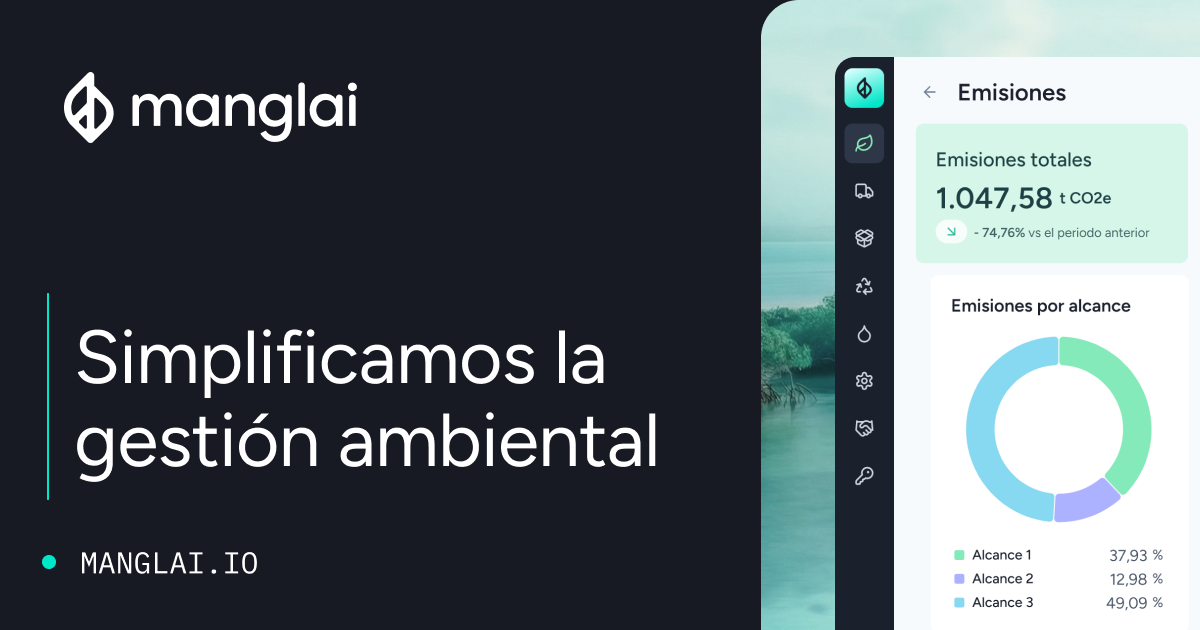
Manglai is a Spanish environmental management platform built around artificial intelligence, covering carbon footprint under the GHG Protocol and ISO 14064, water footprint under ISO 14046, waste, product footprint and logistics under the GLEC Framework and ISO 14083. The practical difference against Persefoni is jurisdictional: it is built on the Spanish framework, including calculation under ISO 14064 and documentation for the MITECO carbon footprint registry.
It fits when your verification will be carried out by an accredited body in Spain, when you bid for public tenders, or when the evidence has to be in Spanish. The company publishes clients in 70 countries, more than 30,000 users, 25 million tonnes of CO2 equivalent under management and an average rating of 4.7 out of 5. Starter, Pro and Enterprise plans, priced by facilities and sector on a 12 month subscription. It does not publish SOC certifications, so if your risk committee requires a SOC 1 Type II, ask up front.
Watershed
Watershed is a US enterprise sustainability platform. It reports more than 90 Fortune 500 companies as customers, including five of the six largest US banks, and is listed as a CDP accredited gold software solutions provider.
The product is organised around measure, report and act, with AI assisted data collection and standardisation, emission factor mapping and a marketplace of clean power projects. On the audit side it publishes full data lineage, review workflows, peer benchmarks and transparency about AI use. It states support for CSRD, the Californian laws SB 253 and SB 261, and CDP reporting. Pricing is not published. It is the closest alternative to Persefoni by customer profile, although its commercial weight sits in the United States.
Normative
Normative is a Swedish platform founded in 2014, with offices in Stockholm, Copenhagen and London and more than 350 stated customers. It calculates scope 1, 2 and 3 against a library it puts at more than 349,000 emission factors.
Its strongest auditability signal is that the calculation methodology is independently verified by TÜV SÜD against the GHG Protocol, and the platform has been evaluated against ISO/IEC 25051. It covers CSRD, SBTi, CDP and CBAM reporting, and each account gets a named climate strategy advisor. Pricing is not published. Against Persefoni it wins on human support and European focus, and loses if you need financed emissions under PCAF or SOC certifications.
Sweep
Sweep is a sustainability data platform for large organisations, the midmarket, financial institutions and asset managers. Its strength is not the one off calculation but the structure of ESG data across subsidiaries and along the value chain.
It states coverage of CSRD, the GHG Protocol, CDP, ISSB, PCAF, GRI, SASB, California SB 253 and the UK SRS regime. PCAF support makes it the closest comparable to Persefoni for financial institutions. It has Enterprise, Midmarket, financial institutions and Sweep Starter plans, with no published figures. Worth it when the problem is consolidating many entities rather than certifying a single calculation.
Workiva Carbon
Workiva is a corporate reporting platform used for financial filings, and Workiva Carbon is its carbon accounting module. It covers scope 1, 2 and 3 including third party supplier data, with GHG Protocol aligned methodologies and a factor library the company places across more than 240 countries, territories and regions, plus AI powered factor matching.
On auditability it is one of the most explicit propositions on the market: data lineage, version history, attached evidence, granular access controls, built in workflows and complete audit trails, all designed for working alongside auditors. It supports CSRD, ISSB, CDP, GRI and SB 253 and SB 261. Pricing is not published. It is the best Persefoni alternative if your organisation already reports in Workiva and wants carbon and financial data in one place. It is expensive and oversized if you do not.
IBM Envizi
IBM Envizi is sustainability data management software aimed at corporates with many sites. It calculates emissions on the GHG Protocol and is structured around emissions management, ESG reporting and decarbonisation, with AI assisted analytics.
Its specific audit advantage is organisational modelling: a customisable hierarchy covering regions, sites, assets and joint ventures, which allows accurate rollups without double counting. IBM does not publish final figures, but it does describe a data volume pricing model organised around Accounts, with Essentials, Standard and Premium tiers, plus an indicative calculator on its pricing page. It is the only tool on this list that documents its pricing logic, even if the final number is settled in negotiation.
How do you choose a Persefoni alternative?
Order the decision with these five questions, in this sequence:
- Who is going to verify your calculation? If it is an accredited body in Spain working under ISO 14064-3, ask for references of verifications already passed using that tool in that country. A SOC 2 does not replace that. Our guide to what the ISO 14064 standard is explains what the verifier looks at.
- Are you inside the CSRD perimeter? After Directive (EU) 2026/470, published in the Official Journal on 26 February 2026, the obligation only reaches companies with more than 1,000 employees and more than 450 million euros in net turnover, with first reports for financial years starting on or after 1 January 2027. Outside that, you do not need the full machinery. The framework is set out in our explainer on the Corporate Sustainability Reporting Directive.
- Do you need financed emissions? If you are a bank, insurer or fund, the PCAF standard narrows the list sharply: Persefoni and Sweep both state support for it.
- How many entities do you consolidate? Beyond about ten companies or sites, hierarchy modelling matters more than any calculation feature.
- Who signs the purchase order? If it is the CFO, the argument is internal control and reporting cycle cost, not charts. That is the angle behind sustainability software for CFOs.
When does staying with Persefoni make sense?
Stay with Persefoni if your auditor has already reviewed its SOC 1 Type II report and accepted it as part of your internal control, because repeating that exercise with another vendor takes months. Stay too if you are a financial institution running financed emissions under PCAF and the SOCOTEC certification forms part of your methodological justification, if you carry obligations under California SB 253 and SB 261, or if the free Pro plan is already solving a calculation that does not yet justify budget. None of the alternatives on this list beats Persefoni on documented internal control.
Frequently asked questions
Is Persefoni free?
Persefoni Pro is offered as a free plan with no trial period and no time limit, according to the company's own pricing page. The Advanced plan is priced on request. It is the only tool in this comparison with a published permanent free tier.
Which Persefoni alternative works for an audit in Spain?
Any platform whose calculation follows ISO 14064-1 and lets you trace every figure back to its source document can pass a verification in Spain. What makes the difference in practice is documentation in Spanish and a vendor with verifications already passed with accredited bodies in the country. Ask for that in writing before signing.
Is verification the same as an audit?
Not exactly. Greenhouse gas verification is governed by ISO 14064-3 and carried out by an accredited body over an emissions statement. Sustainability assurance under CSRD is an assurance engagement over the complete sustainability statement, at limited assurance level. A company may need both.
Do SOC 2 certifications prove a carbon footprint?
No. SOC 2 attests to the software vendor's security, availability and confidentiality controls, not to the accuracy of your emissions. It matters to your risk committee and to procurement, but it does not replace footprint verification under ISO 14064-3.
How long does it take to switch carbon accounting platforms?
It depends on the number of entities and the quality of your starting data, not on the software. What takes time is rebuilding the base year, redocumenting organisational boundaries and remapping emission factors. Schedule it away from your financial year end and keep the previous calculation running in parallel for a full cycle.
If your scenario is a Spanish company that has to pass an accredited verification, bid for public tenders and take its footprint to the MITECO registry with evidence in Spanish, you can see how the Manglai ISO 14064 solution handles it, or start with the wider review of carbon accounting software.
Paula Otero
Environmental and Sustainability Consultant
About the author
Biologist from the University of Santiago de Compostela with a Master’s degree in Natural Environment Management and Conservation from the University of Cádiz. After collaborating in university studies and working as an environmental consultant, I now apply my expertise at Manglai. I specialize in leading sustainability projects focused on the Sustainable Development Goals for companies. I advise clients on carbon footprint measurement and reduction, contribute to the development of our platform, and conduct internal training. My experience combines scientific rigor with practical applicability in the business sector.
Content
Companies that trust us
















Practical guides
New Construction Products Regulation (EU) 2024/3110: a 2026 guide
The construction sector in Europe is entering a new regulatory phase. The new Construction Products Regulation , Regulation (EU) 2024/3110 , redefines ...

Practical guides
Manglai vs Dcycle: a comparison of sustainability software
The Spanish sustainability software market is growing fast. With regulations such as the CSRD and the obligations of Spain's MITECO carbon footprint r ...

Practical guides
SDG guide for Mexican companies: aligning your strategy with the 2030 Agenda
Sustainability is a strategic necessity for companies that want to stay competitive and resilient. In Mexico, the Sustainable Development Goals (SDGs) ...
Guiding businesses towards net-zero emissions through AI-driven solutions.
Product & Pricing
What is Manglai
Features
SQAS
GLEC
GHG Protocol
ISO-14046
ISO-14064
Miteco certification
CSRD
CSDDD
Digital Product Passport
EINF
Prices
Customers
Partners
Solutions by role
Environmental consulting
ESG management solutions
Financial directors
General directors
HR managers
Operations directors
Quality and environment directors
Senior management
Solutions for investment funds
Supply chain managers
Sustainability managers
Transport responsible
© 2026 Manglai. All rights reserved