Practical guides
Sweep alternatives for ESG data management

Paula Otero
Environmental and Sustainability Consultant

The main alternatives to Sweep for ESG data management are Manglai, APlanet, Workiva, IBM Envizi, Normative and Greenly. Sweep targets large organisations and financial institutions, structuring ESG data across subsidiaries and the value chain. Looking elsewhere makes sense if your group is smaller, if your framework is Spanish, or if you want published pricing.
The comparison that matters in this category is not who calculates a footprint best. It is who can hold a data model covering several legal entities, several sites and hundreds of suppliers without double counting creeping in.
What is Sweep and who does it work well for?
Sweep describes itself as a sustainability intelligence platform and targets large organisations, the midmarket, financial institutions, asset managers and private markets firms. The product covers carbon management, supplier emissions tracking, sustainability reporting, decarbonisation strategy and AI capabilities.
It states coverage of CSRD, the GHG Protocol, CDP, ISSB, PCAF, GRI, SASB, California SB 253 and the UK SRS regime. It names plans as Enterprise, Midmarket, financial institutions and Sweep Starter, but publishes no figures on its website.
Sweep works well when the real problem is data architecture: many legal entities, many countries, a long value chain and the need for it all to reconcile under one framework. It is built for large organisations. If your group has three companies and eight sites, you are probably paying for capacity you will never use.
What does a multi entity ESG data platform have to solve?
Before comparing products, be clear about what is genuinely hard when you consolidate several entities. A group that reports consistently has to solve five things:
- Organisational boundaries. The GHG Protocol allows consolidation by operational control, financial control or equity share. The choice changes which emissions are in and which are out. The tool has to support and document your chosen approach rather than impose one.
- Hierarchy and consolidation. Group, company, country, site, asset. Without that structure, any aggregated report is just a stack of spreadsheets.
- Double counting. The classic case is one subsidiary buying from another in the same group. If the model does not flag intragroup transactions, you inflate scope 3.
- Data governance. Who uploads, who reviews, who approves and how often. Without defined roles, year end turns into an email hunt.
- Supplier data. The most expensive part. Settle the data hierarchy before you ask anyone for anything, which is what our guide to the 15 scope 3 categories of the GHG Protocol works through.
Sweep alternatives compared
| Platform | Best suited to | ESG frameworks it states it covers | Multi entity and supply chain | Public pricing |
|---|---|---|---|---|
| Sweep | Large organisations, midmarket, financial institutions and asset managers | CSRD, GHG Protocol, CDP, ISSB, PCAF, GRI, SASB, SB 253, UK SRS | ESG data structure across subsidiaries and the value chain | Not published |
| Manglai | Spanish or Latin American groups with several sites and obligations beyond carbon | GHG Protocol, ISO 14064, MITECO, CSRD, GLEC and ISO 14083, SQAS, ISO 14046 | Site level consolidation with carbon, water, waste and product in one platform | Starter, Pro and Enterprise, figures on request |
| APlanet | SME to multinational, Iberian and Latin American markets | CSRD, GRI, IFRS, ISSB, SFDR, GHG Protocol | Automated ESG data collection and double materiality analysis | Yes, monthly rates published by module and company size |
| Workiva | Organisations already producing financial reports in Workiva | CSRD, ISSB, GRI, SASB, TCFD, GHG Protocol, iXBRL | Cross team collaboration with data lineage, versions and attached evidence | Not published |
| IBM Envizi | Corporates with many sites and a complex group structure | GHG Protocol, CSRD and multiple ESG frameworks | Customisable organisational hierarchy across regions, sites, assets and joint ventures | No figures published, but a documented data volume model with a calculator |
| Normative | Mid sized and large European companies that want expert support | GHG Protocol, CSRD, SBTi, CDP, CBAM | Dedicated supply chain engagement module | Not published |
| Greenly | SME to large account, French and English speaking markets | CSRD, TCFD, IFRS and ISSB, SBTi, CDP, ISO 14067, CBAM, EUDR | Supplier engagement and sustainable procurement module | Not published |
One qualifier on that frameworks column: several vendors still list the TCFD and the SASB Standards as free standing frameworks. The TCFD task force was disbanded in 2023 and its recommendations are embedded in IFRS S2, while the SASB Standards are now maintained by the ISSB within the IFRS Foundation. In practice, covering the ISSB standards covers both.
Manglai
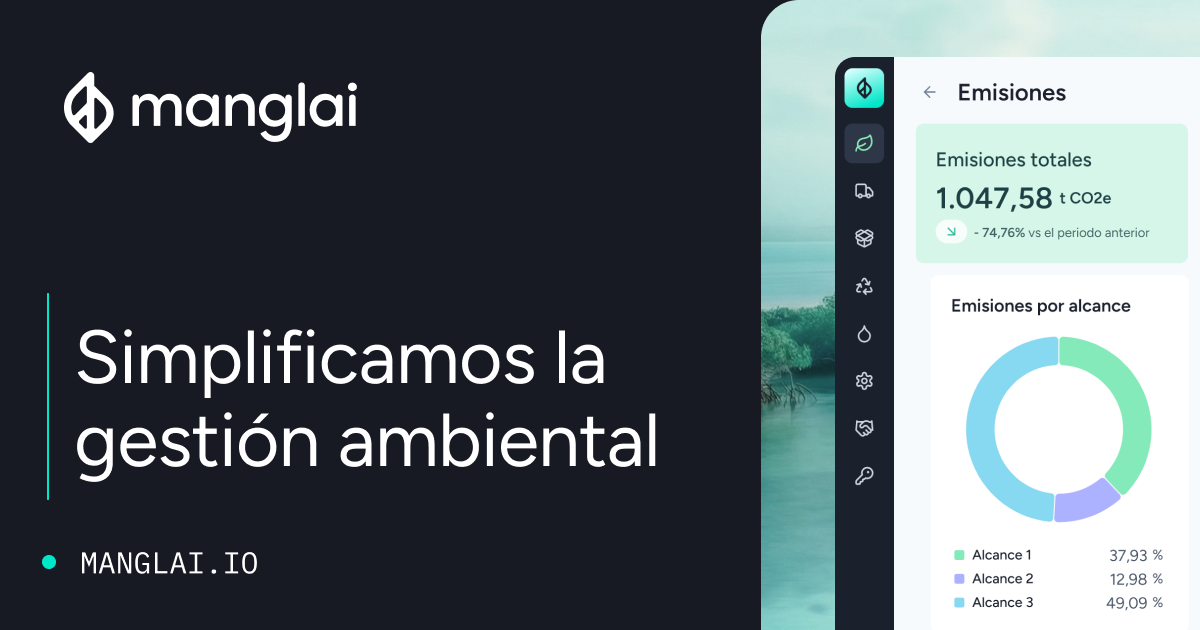
Manglai is a Spanish environmental management platform built around artificial intelligence. Its difference against Sweep is not size but thematic scope: alongside carbon footprint under the GHG Protocol and ISO 14064, it covers water footprint under ISO 14046, waste management with source to disposal traceability, product footprint and logistics emissions under the GLEC Framework and ISO 14083.
For a group with several sites, that means consolidating in one place obligations that normally live in three separate tools. The artificial intelligence layer is applied to capturing and classifying source data, which is where most time disappears when every site sends its information in a different format. The company publishes clients in 70 countries, more than 30,000 users and 25 million tonnes of CO2 equivalent under management. Starter, Pro and Enterprise plans, priced by facilities and sector.
APlanet
APlanet is an ESG management platform with offices in Bilbao, Madrid, Lisbon, Sao Paulo and Mexico, available in Spanish, English, French, Italian and Portuguese. It automates ESG data collection, report production and AI driven analysis, and serves companies of all sizes from SME to multinational.
It is organised into three modules: Sustainability for ESG data management with dashboards and audit capability, Neutrality for carbon footprint and decarbonisation planning, and Materiality for the double materiality analysis CSRD requires. It states coverage of CSRD, GRI, IFRS, ISSB, SFDR and the GHG Protocol. It is the only tool in this comparison that publishes rates on its website: monthly prices per module, with tiers by employee headcount, quotation based pricing for the largest organisations and a discount on multi year contracts. Check its pricing page for the current figures, since they move with each commercial review.
Workiva
Workiva is a corporate reporting platform used for financial filings that has extended its reach into ESG. Its proposition is cross team collaboration: sustainability, finance, HR, risk and compliance working over the same data set.
It supports TCFD, SASB, GRI, CSRD, the UN Sustainable Development Goals and XBRL and iXBRL format validation for regulatory filings. It includes pre built templates for mapping frameworks and an explorer for comparing requirements. Emissions calculation lives in a separate product, Workiva Carbon, with data lineage, version history, attached evidence and granular access controls. Pricing is not published. It is the natural Sweep alternative when the sustainability report has to come out alongside the financial one, with the same audit trail.
IBM Envizi
IBM Envizi is sustainability data management software for corporates. It automates data capture from multiple sources and offers AI assisted analytics across emissions, ESG reporting and decarbonisation.
Its specific strength for the multi entity case is organisational modelling: a customisable hierarchy covering regions, sites, assets and joint ventures, with accurate rollups across the group structure. IBM does not publish final figures, but it does describe a data volume pricing model organised around Accounts, with Essentials, Standard and Premium tiers, plus an indicative calculator on its pricing page. It is the option to look at when the problem is purely scale and structure rather than functionality.
Normative
Normative is a Swedish platform founded in 2014 with more than 350 stated customers and offices in Stockholm, Copenhagen and London. It calculates scope 1, 2 and 3 against a library it puts at more than 349,000 emission factors, with methodology independently verified by TÜV SÜD.
It has a dedicated supply chain engagement module, alongside product carbon footprint, SBTi target setting, CSRD compliance and CBAM reporting. Each account gets an assigned climate strategy advisor. Pricing is not published. Against Sweep it is narrower in ESG breadth, because its centre of gravity is carbon, and stronger on human support for supplier campaigns. Automating that collection is a subject in itself, covered in our analysis of AI applied to scope 3 calculation with supplier data.
Greenly
Greenly is a French carbon intelligence platform reporting more than 3,500 clients, from small businesses to large accounts. It covers corporate footprint, life cycle assessment, supplier engagement, decarbonisation strategy and an ESG management module, backed by a consultant network.
It states coverage of CSRD, TCFD, IFRS and ISSB, SBTi, CDP accreditation, ISO 27001 and ISO 14067, SASB, CARB, EUDR, CBAM and the Digital Product Passport, and includes an AI assistant called EcoPilot. Pricing is not published. It is a reasonable Sweep alternative for a mid sized European group that needs broad regulatory coverage and values having consultants on hand, though its data model is less geared to complex group structures.
How do you choose a Sweep alternative?
Five questions order the decision:
- How many legal entities do you consolidate, and on what basis? Above ten companies, ask for a demo using your own org chart rather than the sample one. Check how it handles joint ventures and intragroup transactions.
- Are you inside the CSRD perimeter? After Directive (EU) 2026/470, published in the Official Journal on 26 February 2026, the obligation reaches companies with more than 1,000 employees and more than 450 million euros in net turnover, with first reports for financial years starting on or after 1 January 2027. The European Commission also adopted the simplified ESRS and the voluntary VSME standard as delegated acts on 3 July 2026. If your group falls outside, the bar is different.
- Does the pressure reach you as a supplier or as a parent company? Building a supplier data collection programme is not the same job as answering a large customer. The second case is covered in our guide to CSRD and supply chain SMEs.
- What do you measure besides carbon? If waste, water or product footprint sit inside the same perimeter, a carbon only platform leaves three processes outside.
- Is there budget for a project or only for a licence? Platforms in this segment usually imply an assisted rollout. APlanet is the only one that lets you estimate cost before talking to sales. For the rest, the market reference is our review of ESG management software.
When does staying with Sweep make sense?
Stay with Sweep if you are a financial institution or asset manager and you need PCAF, because that framework genuinely narrows the category and few platforms state support for it. Stay too if your group already has its data model built in Sweep and it works, because rebuilding an entity hierarchy in another tool is a months long project, not a migration. And stay if you operate under CSRD, California SB 253 and the UK SRS regime at the same time, a combination very few platforms cover together. The right alternative depends on the size of your structure, not on the feature list.
Frequently asked questions
How much does Sweep cost?
Sweep does not publish figures on its website as of August 2026. It names Enterprise, Midmarket, financial institutions and Sweep Starter plans and directs visitors to book a demo. Of the alternatives compared here, only APlanet publishes monthly rates, and IBM describes its data volume pricing logic without giving the final figure.
Which Sweep alternative works for a group with several Spanish subsidiaries?
Any tool that supports and documents your consolidation approach. What you should test with your own org chart is how it treats minority holdings, intragroup transactions and shared sites. If you also need the MITECO registry or evidence in Spanish, that narrows the list considerably.
Do I need an ESG platform or is a carbon footprint tool enough?
It depends on what you have to report. If your obligation is to calculate your footprint and hold a reduction plan, a carbon platform is enough. If you have to produce a sustainability statement with social and governance indicators, you need an ESG platform. Our review of sustainability management software for CSRD works through the difference.
How do you avoid double counting between subsidiaries?
By defining the organisational boundary before loading any data, and flagging intragroup transactions as such in the system. A purchase by one subsidiary from another in the same group should not enter the consolidated group's scope 3, although it does belong in each company's individual calculation. If the tool cannot make that distinction, you will be adjusting it by hand every year.
How long does a multi entity rollout take?
Timing is set by your data quality and the number of people involved, not by the software. Defining the hierarchy, assigning owners per site and agreeing an upload cadence usually takes longer than the technical configuration. Start with one pilot site, close a full cycle and then replicate.
If your case is a Spanish or Latin American group with several sites that needs carbon, water, waste and logistics consolidated in one platform with evidence in Spanish, you can see how the Manglai carbon footprint module approaches it, or the angle built for supply chain managers.
Paula Otero
Environmental and Sustainability Consultant
About the author
Biologist from the University of Santiago de Compostela with a Master’s degree in Natural Environment Management and Conservation from the University of Cádiz. After collaborating in university studies and working as an environmental consultant, I now apply my expertise at Manglai. I specialize in leading sustainability projects focused on the Sustainable Development Goals for companies. I advise clients on carbon footprint measurement and reduction, contribute to the development of our platform, and conduct internal training. My experience combines scientific rigor with practical applicability in the business sector.
Content
Companies that trust us
















Practical guides
New Construction Products Regulation (EU) 2024/3110: a 2026 guide
The construction sector in Europe is entering a new regulatory phase. The new Construction Products Regulation , Regulation (EU) 2024/3110 , redefines ...

Practical guides
Manglai vs Dcycle: a comparison of sustainability software
The Spanish sustainability software market is growing fast. With regulations such as the CSRD and the obligations of Spain's MITECO carbon footprint r ...
Practical guides
SDG guide for Mexican companies: aligning your strategy with the 2030 Agenda
Sustainability is a strategic necessity for companies that want to stay competitive and resilient. In Mexico, the Sustainable Development Goals (SDGs) ...
Guiding businesses towards net-zero emissions through AI-driven solutions.
Product & Pricing
What is Manglai
Features
SQAS
GLEC
GHG Protocol
ISO-14046
ISO-14064
Miteco certification
CSRD
CSDDD
Digital Product Passport
EINF
Prices
Customers
Partners
Solutions by role
Environmental consulting
ESG management solutions
Financial directors
General directors
HR managers
Operations directors
Quality and environment directors
Senior management
Solutions for investment funds
Supply chain managers
Sustainability managers
Transport responsible
© 2026 Manglai. All rights reserved