Legislation and regulation
Carbon footprint registry: what changes under Royal Decree 214/2025

Paula Otero
Environmental and Sustainability Consultant

Royal Decree 214/2025 of 18 March completely renews MITECO's Registry of carbon footprint, offsetting and carbon dioxide absorption projects. It repeals and replaces the earlier Royal Decree 163/2014 and, in addition, introduces the obligation to calculate the carbon footprint and publish a reduction plan for large companies and the state public sector.
It was published in Spain's Official State Gazette on 12 April 2025 and entered into force on 12 June 2025. Below we review the key changes and how they affect organisations.
Mandatory carbon footprint calculation and reduction plan
The main change is the obligation to calculate the carbon footprint and to prepare an emissions reduction plan with a minimum horizon of five years and quantified targets. This obligation falls on organisations that already have to file a non-financial statement, that is:
- Companies with more than 250 employees that are public-interest entities, or that exceed, for two consecutive financial years, €20 million in total assets or €40 million in net turnover.
- Ministerial departments, autonomous agencies and other entities of the state administrative public sector.
Both groups must publish the footprint and the plan free of charge and accessibly on their website. Companies meet this obligation through their sustainability report and are not required to enter the registry, which remains voluntary for the private sector; the state public sector does have to register its footprint annually.
According to the clarifying note published by MITECO in December 2025, the footprint and the reduction plan must be published within six months of the end of the financial year, and the calculation may cover any twelve consecutive months, not necessarily the calendar year.
Carbon footprint of events: a new category
The text introduces the carbon footprint of events, covering the direct and indirect emissions of activities such as trade fairs, conferences or festivals. A major event is defined as one exceeding 1,500 in-person attendees, for which footprint calculation, verification and, where applicable, registration take on particular importance.
Integrating blue carbon and new absorption projects
The concept of sink is broadened to include blue carbon, that is, the carbon stored in marine and coastal ecosystems such as mangroves, salt marshes and seagrass meadows. This opens the door to more diverse absorption projects aligned with biodiversity conservation.
A more interoperable registry
The rule strengthens the interoperability of the state registry with the regional carbon footprint registries. Communities with their own registry will be able to integrate their data, provided their requirements are compatible, through a system coordinated by the Spanish Climate Change Office, reducing the administrative burden for companies operating in several regions.
The three sections of the registry
The registry is divided into three sections:
- Section a): carbon footprints of organisations and events, together with reduction commitments.
- Section b): CO₂ absorption projects in national territory.
- Section c): carbon footprint offsetting through verified absorptions.
Scopes 1, 2 and 3: what goes into the calculation
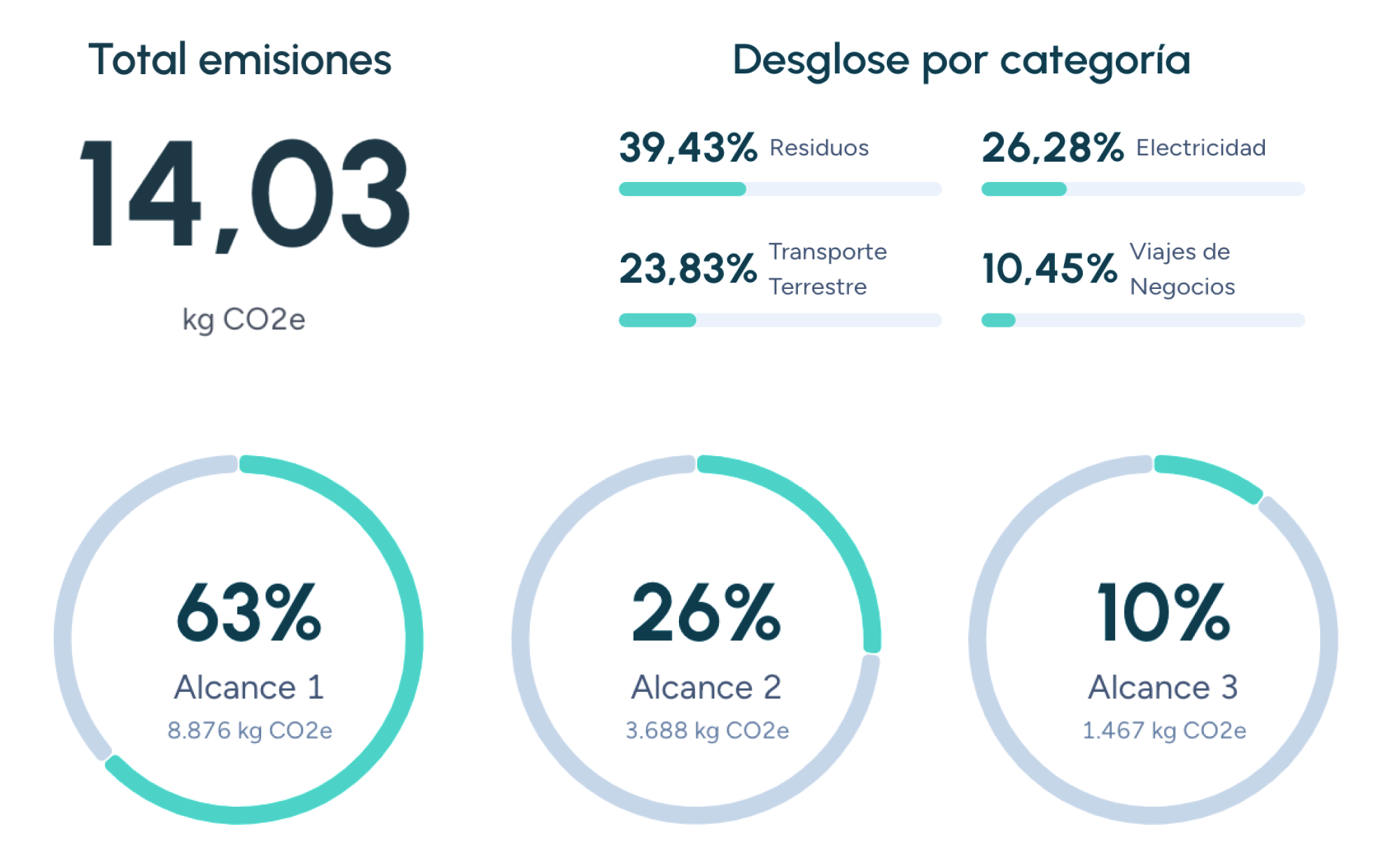
The calculation must include Scope 1 (direct) and Scope 2 (indirect from energy use) emissions. Scope 3 (other indirect emissions in the value chain) is voluntary under the Royal Decree, although strongly recommended where it is significant: in most sectors it concentrates the bulk of the total and it is what clients, banks and public tenders ask for.
Verification and control of absorption projects
Scope 1 and 2 footprints must be verified by an accredited body, except where official emission factors from the Spanish Climate Change Office are used and the footprint belongs to an SME, association, foundation, cooperative or public administration. Registered absorption projects must meet monitoring, traceability and permanence requirements, and any significant change (such as a fire) must be reported.
Timeline: what to do and when
The obligation applies from the footprint of the 2025 financial year, calculated and published in 2026. The state public sector registers its first footprint (that of 2025) in 2026. It is therefore worth starting to collect data and design the reduction plan as soon as possible.
| Milestone | Date |
|---|---|
| Publication in the Official State Gazette | 12 April 2025 |
| Entry into force | 12 June 2025 |
| First mandatory footprint | 2025 financial year (calculated and published in 2026) |
| Deadline to publish footprint and plan | Six months after the end of the financial year |
| Scope 3 | Voluntary |
How to register
Registration, voluntary for companies, has three phases:
- Emissions calculation: an inventory of direct GHG (Scope 1) and indirect GHG (Scope 2 and, if you choose to include it, Scope 3), using a recognised methodology such as ISO 14064 or the GHG Protocol.
- Verification: where applicable, an accredited body verifies the inventory.
- Registration on the official MITECO platform, attaching the footprint and, where relevant, the reduction plan.
If you want to obtain official recognition, see our guide to the Calculate, Reduce and Offset seals and, for the full context of the rule, the article on the obligation to calculate and reduce the carbon footprint.
To check whether your organisation is in scope and prepare the registration with confidence, you can rely on Manglai's MITECO registry solution.
Paula Otero
Environmental and Sustainability Consultant
About the author
Biologist from the University of Santiago de Compostela with a Master’s degree in Natural Environment Management and Conservation from the University of Cádiz. After collaborating in university studies and working as an environmental consultant, I now apply my expertise at Manglai. I specialize in leading sustainability projects focused on the Sustainable Development Goals for companies. I advise clients on carbon footprint measurement and reduction, contribute to the development of our platform, and conduct internal training. My experience combines scientific rigor with practical applicability in the business sector.
Content
Companies that trust us















Legislation and regulation
CBAM timeline 2026 and 2027: authorised declarant, annual declaration and certificates
If you import iron and steel, cement, aluminium, fertilisers, electricity or hydrogen, four dates govern your calendar: since 1 January 2026 only an a ...

Legislation and regulation
CSRD transposition in Spain: where the sustainability reporting law stands
As of 7 September 2026, Spain still has not transposed the CSRD . The draft Sustainability Reporting Law (Proyecto de Ley de Información Empresarial s ...
Legislation and regulation
Environmental and sustainability regulation for companies in Chile
A company operating in Chile does not face a single environmental law but four regulatory blocks with different regulators, thresholds, platforms and ...
Guiding businesses towards net-zero emissions through AI-driven solutions.
Product & Pricing
What is Manglai
Features
SQAS
GLEC
GHG Protocol
ISO-14046
ISO-14064
Miteco certification
CSRD
CSDDD
Digital Product Passport
EINF
Prices
Customers
Partners
Solutions by role
Environmental consulting
ESG management solutions
Financial directors
General directors
HR managers
Operations directors
Quality and environment directors
Senior management
Solutions for investment funds
Supply chain managers
Sustainability managers
Transport responsible
© 2026 Manglai. All rights reserved